
Imagine you have just finished writing an email to a client, manager, colleague, or professor. You have included the answer, a schedule, a list of documents, or some important details farther down in the message. You type: “Please see below.” It is clear, polite, and familiar—but it may not always be the best wording for the situation.
“Please see below” is a standard written expression used to direct someone to information that appears later in an email, document, report, or message. The phrase is especially common in professional English because it is short and easy to understand. However, alternatives such as “Please refer to the details below,” “I’ve included the information below,” or “Here are the details you requested” can make communication sound more natural, precise, or friendly.
The best choice depends on your audience, purpose, relationship with the reader, and desired tone. For ESL learners, students, professionals, and content writers, understanding these differences can make everyday English more confident and effective.
What Does “Please See Below” Mean?
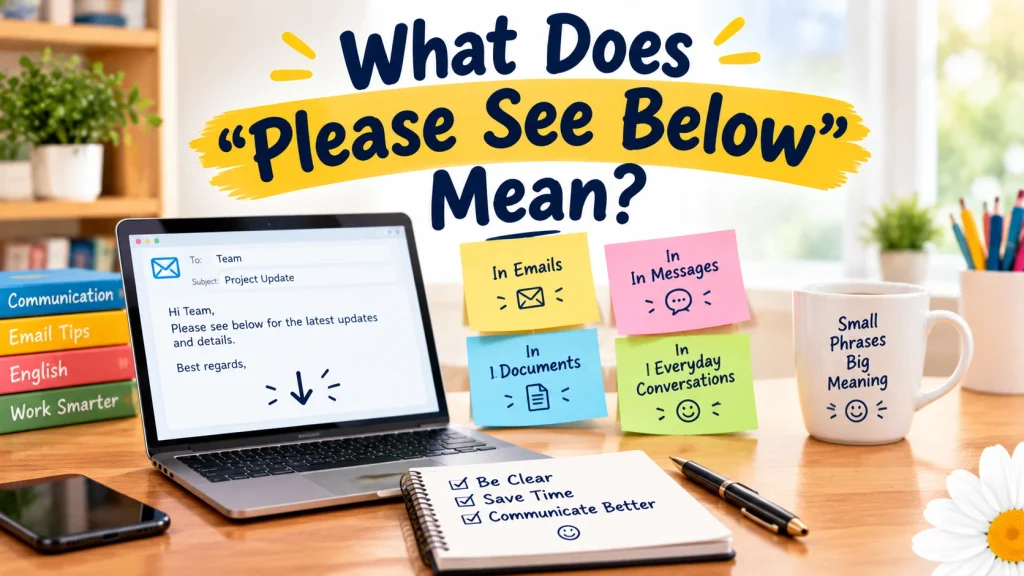
“Please see below” is a written instruction that asks the reader to look farther down in the same email, document, or message for relevant information. It commonly introduces details, answers, instructions, lists, tables, explanations, or updates. The phrase is neutral and professional, and its main purpose is to guide the reader efficiently to content that follows.
In simple English, “please see below” means “please look at the information provided farther down.”
For example:
Please see below for the updated project timeline.
The reader understands that the timeline appears after the sentence.
It can also refer to:
- An answer to a question
- A list of requested documents
- Meeting notes
- Pricing information
- Instructions
- A project update
- A table or chart
- A response to an earlier email
- Details copied from another message
The phrase does not normally mean that the reader must literally “see” something visually. In written communication, “see” can mean “look at,” “read,” “consider,” or “refer to.”
Origin & History of “Please See Below”
There is no single historical event that created the complete phrase “please see below.” It is better understood as a combination of ordinary English words that gradually became useful in written communication.
The verb “see” has a very old history. It comes from Middle English seen and Old English sēon, with the basic meaning of perceiving with the eyes and related senses such as understanding or inspecting. (Etymology Online)
The word “below” is also old. It appeared in English in the early 14th century and developed from forms meaning “in a lower position.” It became increasingly common over time, while older words such as “beneath” had previously carried much of the same positional meaning. (Etymology Online)
As written correspondence became increasingly structured—particularly through letters, office documents, reports, memoranda, and eventually email—phrases that directed readers to another part of a document became increasingly useful.
Modern email strengthened this pattern. When someone writes “Please see below,” the phrase works as a small navigational instruction: it tells the reader where the relevant information is located without repeating it.
The meaning has therefore remained fairly stable. What has changed is how natural and appropriate the phrase feels in different communication environments. Traditional business correspondence tends to favor formulas such as “please see below” and “please find below,” while modern workplace communication often favors more direct alternatives such as “I’ve included the details below.”
Synonyms & Alternatives by Tone
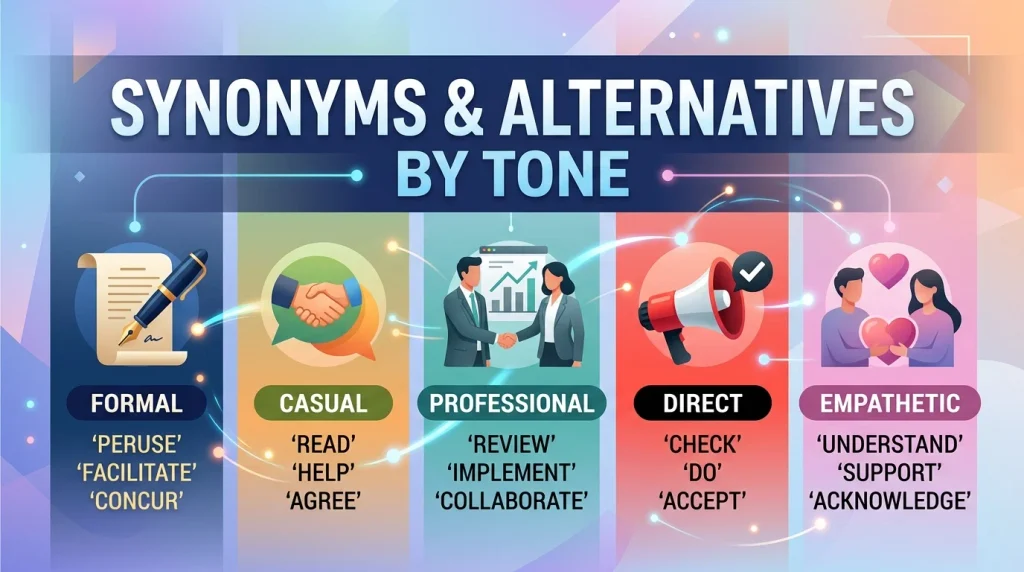
Professional & Neutral Alternatives
- Please refer to the information below.
- Please see the details below.
- Please refer to the details below.
- See the information below.
- The details are provided below.
- The information is included below.
- Please review the information below.
- Please find the details below.
Polite & Supportive Alternatives
- I’ve included the information below.
- I’ve added the details below.
- You’ll find the information below.
- Here are the details you requested.
- The requested information is included below.
- I’ve provided the details below.
- Please review the information below.
Encouraging & Reassuring Alternatives
- I’ve included everything you need below.
- You’ll find the relevant details below.
- I’ve outlined the next steps below.
- The information you need is included below.
- I’ve put the key points together below.
Casual, Playful & Idiomatic Alternatives
- Here’s the information you need.
- I’ve added the details here.
- Take a look below.
- Here are the details.
- Check out the details below.
- You can find the details below.
- Everything is listed below.
When Should You Use “Please See Below”?
“Please see below” works best when the reader genuinely needs to look farther down the message. It is especially useful when information follows immediately, and the wording helps the reader navigate a longer message.
Professional settings
The phrase works well in:
- Business emails
- Customer-service messages
- Internal workplace communication
- Project updates
- Administrative correspondence
- Meeting follow-ups
- Reports and memos
For example:
Please see below for the revised delivery schedule.
This is concise and professional without sounding excessively formal.
Casual conversations
It is grammatically fine in casual written communication, but it can sound more formal than necessary.
Instead of:
Please see below for the restaurant options.
A friend might naturally write:
Here are the restaurant options.
Writing, presentations, and digital communication
The phrase can also work in:
- Reports
- Online forms
- Written presentations
- Documentation
- Help pages
- Email newsletters
- Internal knowledge bases
It is particularly effective when the content is visually organized, and the reader needs a clear signpost.
When it is especially effective
Use it when:
- The relevant information is actually below.
- The reader needs to locate that information.
- The message has enough content that a signpost is useful.
- A neutral professional tone is appropriate.
- You want to avoid repeating information.
A good rule is simple: if the reader can immediately find what you are pointing to, “please see below” can be perfectly effective.
When Should You Avoid “Please See Below”?
Although the phrase is correct, there are situations where another expression is clearer or more natural.
Overly formal situations
For highly polished writing, repeating formulaic phrases can make the prose sound mechanical.
Instead of:
Please see below for my thoughts.
Consider:
I’ve outlined my recommendations below.
The second version tells the reader more specifically what follows.
Legal, academic, or sensitive contexts
In legal, academic, medical, financial, or other sensitive communication, specific references are often better than vague directions.
Instead of:
Please see below.
Use:
Please refer to Section 3, “Payment Terms,” below.
This reduces ambiguity.
Situations where nuance may be lost
“Please see below” does not tell the reader why the information matters.
Compare:
Please see below.
with:
I’ve outlined the three changes that affect your deadline below.
The second version gives the reader useful context before asking them to continue reading.
When the information is not immediately below
Do not use the phrase if the reader has to search through several pages, another document, or a separate website.
In that situation, write a precise direction:
Please refer to the attached pricing sheet on page 4.
Precision is more helpful than a generic pointer.
Is “Please See Below” Professional, Polite, or Casual?
“Please see below” is generally professional and polite, with a neutral level of formality. It is not particularly warm, emotional, or casual.
Its tone can be understood as:
| Feature | Assessment |
| Professional | High |
| Polite | High |
| Formal | Moderate |
| Casual | Low |
| Friendly | Moderate |
| Emotional | Very low |
| Direct | Moderate |
The word “please” softens the instruction. Without it, “See below” is more direct.
Compare:
See below for the updated figures.
Please see below for the updated figures.
The second version sounds more courteous.
However, “please” does not automatically make every sentence warm. In a workplace where the phrase appears repeatedly, “please see below” can begin to sound formulaic or impersonal.
That is why experienced communicators often change the wording according to context.
Pros and Cons of Using “Please See Below”
Advantages
Clarity: It immediately tells the reader where to look.
Efficiency: It avoids repeating information.
Accessibility: ESL learners and readers with different levels of English proficiency can usually understand it easily.
Professional tone: It fits most workplace emails.
Useful structure: It creates a clear transition between an introduction and the information that follows.
Potential Drawbacks
Oversimplification: It may not explain what the reader should expect to find.
Tone mismatch: It can sound stiff in a friendly conversation.
Repetition: Frequent use can make emails sound formulaic.
Lack of specificity: “Below” does not identify the exact section, table, or point.
Digital limitations: On phones or long messages, the reader may still have to scroll considerably.
The phrase is therefore neither inherently good nor bad. Its effectiveness depends on whether it gives the reader enough useful direction.
Real-Life Examples of “Please See Below” by Context
Emails
Hi Maya,
Thanks for sending the revised proposal. Please see below for my comments on the three sections we discussed.
- Timeline — looks good.
- Budget — please update the final figure.
- Deliverables — I’ve added one clarification.
Best,
Daniel
Meetings
After a meeting, a written follow-up might say:
Thanks, everyone, for joining today. Please see below for the agreed action items and owners.
This works because the phrase introduces information that directly follows.
Presentations
A written presentation might use:
Please see below for a summary of the survey findings.
This is more natural in speaker notes or accompanying documentation than in spoken conversation.
Conversations
In everyday speech, a person would rarely say:
Please see below.
Instead, they would normally say:
Take a look at this part.
or:
I’ve put the details here.
Social media
The phrase is relatively uncommon in normal social-media writing because social platforms generally favor short, conversational language.
Instead of:
Please see below for the full announcement.
A more natural version might be:
Full announcement below.
“Please See Below” vs Similar Expressions (Key Differences)
| Phrase | Meaning Difference | Tone Difference | Best Use Scenario |
| Please see below | Directs the reader to information below | Neutral, professional | General business emails |
| Please refer to the information below | Explicitly asks the reader to consult the information | More formal | Reports, instructions, official communication |
| Please find the details below | Presents the details as something located below | Formal, traditional | Business correspondence |
| I’ve included the details below | Tells the reader that the writer deliberately added the information | Natural, collaborative | Modern workplace emails |
| Here are the details | Simply introduces the information | Friendly, direct | Colleagues, customers, casual communication |
| See the details below | Removes “please” and becomes more direct | Brief, neutral | Internal notes and quick messages |
The differences are subtle, but they matter when you want your writing to sound natural rather than formulaic.
Common Mistakes & Misuse of “Please See Below”
1. Overusing the phrase
Using it in every email can make your writing repetitive.
Vary the wording:
Here are my responses.
I’ve added my comments below.
I’ve outlined the next steps below.
2. Using “below” when the information is elsewhere
Do not write “please see below” when the information is actually in an attachment.
Better:
Please refer to the attached report.
3. Using awkward noun order
A common ESL error is:
Please see below details.
A more natural construction is:
Please see the details below.
or:
Please see below for the details.
The placement of “below” depends on the sentence structure.
4. Giving no context
Please see below.
This may be technically correct but unhelpful if the reader does not know what to look for.
Better:
Please see below for the updated payment schedule.
5. Using it in speech
“Please see below” is primarily a written expression. In a live conversation, it may sound unnatural unless you are referring to a shared screen or document.
Psychological Reason People Prefer “Please See Below”
The popularity of “please see below” is partly practical.
Cognitive load reduction
Readers scan emails. A short directional phrase tells them that additional information follows, reducing the need to guess where the relevant content is.
Trust and authority signals
Professional formulas can signal familiarity with workplace conventions. The phrase sounds organized and controlled, especially when followed by clearly structured information.
Attention economy
Modern readers often skim rather than read every sentence. A signpost such as “please see below” helps establish the relationship between the introductory sentence and the information that follows.
Modern communication habits
Email, messaging platforms, and online documents encourage short navigational cues. People need to know quickly what matters and where to find it.
Still, excessive use can have the opposite effect. Once a phrase becomes predictable, readers may mentally ignore it.
US vs UK Usage of “Please See Below”
There is no major grammatical difference between American and British English regarding “please see below.” Both varieties understand and use the expression.
The main differences are stylistic.
US English
American workplace writing often favors direct, streamlined wording:
I’ve included the details below.
Here are the requested figures.
UK English
British professional correspondence may more readily tolerate traditional business formulas such as:
Please see below.
Please find below the requested information.
These are tendencies rather than strict rules. Individual workplaces, industries, and writers vary considerably.
For international communication, “Please see the details below” is a safe choice because it is clear in both varieties.
“Please See Below” in Digital & Modern Communication
Emails
Email remains the strongest context for the phrase. It is particularly useful for long messages containing structured information.
Slack / WhatsApp
In workplace chat, the phrase may sound unnecessarily formal.
Instead of:
Please see below for my thoughts.
A colleague might write:
I’ve added my thoughts below.
Social media
Social media usually favors shorter expressions:
Details below.
Full list below.
More information here.
AI-generated summaries
AI-generated emails and summaries frequently use phrases such as “please see below” because the wording is grammatically safe and broadly applicable. However, human editors should consider whether a more specific sentence would improve clarity.
For example:
Please see below for more information.
is weaker than:
I’ve summarized the three key changes below.
The second sentence communicates what the reader will gain by continuing.
Linguistic & Communication Insight
Emotional weight & subtext
The literal meaning of “please see below” is simple, but readers can perceive a little more than the words themselves.
The phrase usually signals:
- Organization
- Professional distance
- Politeness
- A request for attention
- Low emotional involvement
It does not normally communicate enthusiasm, urgency, empathy, or reassurance by itself.
That makes it useful when the content is factual, but less effective when the communication requires emotional sensitivity.
Direct vs indirect phrasing
There is a small difference between:
See below.
and:
Please see below.
The first is more direct. The second softens the instruction.
An even more collaborative option is:
I’ve included the details below.
Here, the writer is not simply telling the reader what to do. The writer is emphasizing their own contribution.
A softer alternative is:
You’ll find the information below.
This reduces the feeling of an instruction.
Professional communication perspective
In workplace communication, “please see below” is usually safe but not especially expressive. It works when the main goal is navigation.
If the message involves disagreement, feedback, a correction, or a sensitive issue, a more contextual sentence may be better.
Compare:
Please see below for my concerns.
with:
I’ve outlined a few concerns below so we can address them together.
The second version creates a more collaborative impression.
Pragmatic reasons for alternatives
Experienced communicators often replace “please see below” because they want to accomplish more than pointing to information.
They may want to:
- Reduce defensiveness
- Sound collaborative
- Show ownership
- Add warmth
- Explain why the information matters
- Highlight an important action
- Make the reader’s next step obvious
That is why “I’ve included…” can feel more human than “Please see…”.
Social signaling
Word choice influences how people perceive the writer.
“Please see below” can suggest:
I am directing you to information.
“I’ve included the details below” can suggest:
I have prepared this information for you.
“Here are the details you requested” can suggest:
I am responding directly to your needs.
The factual content may be identical, but the social relationship changes slightly.
Tone & context guidance
Use “please see below” when clarity and efficiency are more important than warmth.
Choose an alternative when:
- The reader may be sensitive to directives.
- You want to sound collaborative.
- You need to explain what follows.
- The communication is informal.
- You want to avoid repetitive corporate language.
- The information is especially important and needs context.
Please Refer to the Information Below
Meaning: This phrase politely directs the reader to consult information appearing farther down in the document or message. It is slightly more formal and explicit than “please see below.”
Why This Phrase Works: It clearly identifies the purpose of the reader’s action: referring to information rather than simply looking at something.
Real-World Usage Insight: This works especially well when a document contains policies, instructions, procedures, or supporting information.
Best Use: Reports, formal emails, instructions, administrative communication, and professional documents.
Avoid When: Writing a casual message to a friend or colleague where simpler wording would sound more natural.
Tone: Formal, precise, professional.
US vs UK Usage: Natural in both varieties of English; British professional writing may use this formal structure particularly comfortably.
Example (Email / Message / Meeting):
Please refer to the information below before submitting the revised application.
Please See the Details Below
Meaning: This phrase tells the reader that specific details are provided farther down in the message or document.
Why This Phrase Works: Adding “the details” makes the instruction more specific than simply saying “please see below.”
Real-World Usage Insight: It is a strong everyday replacement when you want to keep the professional tone while making the sentence more informative.
Best Use: Business emails, project updates, customer communication, and meeting follow-ups.
Avoid When: The material below is not actually a set of details—for example, when it is a complete argument or personal explanation.
Tone: Neutral, professional, clear.
US vs UK Usage: Widely natural in both US and UK English.
Example (Email / Message / Meeting):
Please see the details below before confirming the delivery date.
Conclusion
“Please see below” is a clear, polite, and widely understood phrase used to direct readers to information that appears later in an email, document, report, or message. Its professional and neutral tone makes it suitable for many workplace situations, but it is not always the most natural choice. In modern communication, alternatives such as “I’ve included the details below,” “Here are the details you requested,” and “Please refer to the information below” can provide greater clarity or better match the relationship between the writer and reader.
Choosing the right alternative depends on your audience, purpose, and desired tone. For formal documents, a precise phrase such as “Please refer to the details below” may work best. For everyday professional emails, “I’ve included the information below” often sounds more conversational and collaborative. Understanding these subtle differences helps professionals, students, ESL learners, and content writers communicate with greater confidence, accuracy, and professionalism.
FAQs
What does “Please See Below” mean?
“Please see below” means “please look at the information provided farther down.” It is commonly used in emails, reports, messages, and other written communication to direct the reader toward additional information. The phrase is generally neutral and professional and may introduce details, instructions, answers, documents, tables, or updates.
Is “Please See Below” grammatically correct?
Yes, “please see below” is grammatically correct and widely used in professional English. The phrase uses “see” as a direction to look at or consult information appearing later in the text. Depending on context, alternatives such as “please see the details below” or “I’ve included the information below” may sound more specific or natural.
Is “Please See Below” professional?
Yes, “please see below” is considered professional and polite, particularly in workplace emails and formal written communication. However, repeated use can sound formulaic or slightly dated. In modern business writing, “I’ve included the details below” or “Here are the details you requested” may create a more natural, collaborative tone.
Is “Please See Below” formal or casual?
“Please see below” is more formal than casual. It is common in professional emails, reports, administrative messages, and business correspondence. In casual conversations, alternatives such as “Here are the details,” “Take a look below,” or “I’ve added the information here” usually sound more natural and conversational.
What is a better alternative to “Please See Below”?
A strong modern alternative is “I’ve included the details below.” It keeps the meaning clear while sounding more collaborative and natural. Other useful choices include “Please refer to the information below,” “Here are the details you requested,” “You’ll find the information below,” and “I’ve provided the details below.”
Can I use “Please See Below” in an email?
Yes. “Please see below” is appropriate for many professional emails, especially when information follows immediately in the message. For example: “Please see below for the updated project timeline.” When responding to a specific request, “Here are the details you requested” can sound more personal and reader-focused.
What is the difference between “Please See Below” and “Please Find Below”?
Both phrases direct readers to information that follows, but their tone differs slightly. “Please see below” is generally more straightforward and modern, while “please find below” has a more traditional business-writing style. Both are acceptable in professional English, although many modern writers prefer clearer wording such as “I’ve included the details below.”
Is “Please See Below” rude?
No, “please see below” is not normally considered rude. The word “please” makes the instruction polite, while the phrase itself is neutral. However, tone depends on context and repetition. In a sensitive conversation, a warmer alternative such as “I’ve included some information below for you” may feel more considerate.
What can I say instead of “Please See Below”?
You can choose an alternative based on your desired tone. Professional options include “Please refer to the information below” and “Please see the details below.” More conversational choices include “I’ve included the details below,” “Here are the details you requested,” and “You’ll find the information below.” The best choice depends on context and audience.
Is “Please See Below” used in American and British English?
Yes. “Please see below” is understood and used in both American and British English. There is no major grammatical difference between the two varieties. British professional writing may sometimes use traditional expressions such as “please find below,” while American workplace writing often favors direct alternatives such as “I’ve included the details below.”

