
Imagine someone writing wedding vows and wanting to express lifelong commitment without sounding overly traditional: “I promise to stand by you for as long as we both shall live.” The meaning is close to “till death do us part,” but the tone feels more contemporary and personal.
The phrase “till death do us part” is one of the best-known expressions associated with marriage. It communicates a promise to remain committed to a spouse throughout life, traditionally implying that the marriage will continue until one partner dies. Although familiar and emotionally powerful, it can sound formal, religious, old-fashioned, or dramatic depending on the situation.
Knowing alternative expressions helps writers and speakers choose wording that matches their audience. A wedding ceremony may welcome traditional language, while a modern wedding website, personal message, professional biography, or everyday conversation may benefit from a simpler expression. This guide explains the phrase, its history, tone, usage, alternatives, and practical differences between similar expressions.
What Does “Till Death Do Us Part” Mean?

“Till death do us part” means that two married people promise to remain together and committed to each other for the rest of their lives, until the death of one spouse ends the marriage. It is most commonly associated with wedding vows and marriage ceremonies, although it can also be used figuratively to describe an extremely strong or permanent commitment.
Origin & History of “Till Death Do Us Part”
The expression has deep roots in English-language Christian marriage ceremonies. Its familiar form is closely associated with the Book of Common Prayer, first published in England in 1549 under Thomas Cranmer. Earlier marriage traditions contained similar ideas about lifelong marital commitment, but the wording became especially recognizable through Anglican liturgy.
The traditional wedding vow commonly used wording such as “till death us do part.” This word order reflects an older form of English. Modern English would normally say “until death parts us” or “until death separates us.”
The expression became culturally prominent because marriage ceremonies repeated it across generations. It eventually moved beyond strictly religious settings and became a familiar phrase in literature, films, television, songs, wedding speeches, and popular culture.
Its meaning has remained relatively stable: a commitment intended to last for the duration of a person’s life. However, its social interpretation has changed. Today, some speakers hear it as romantic and traditional, while others regard it as solemn, old-fashioned, religious, or overly absolute.
It is also important to distinguish the traditional phrase from modern legal or social ideas about marriage. “Till death do us part” is a statement of commitment, not a legal description of every modern marriage. Divorce and separation mean that contemporary couples may understand lifelong commitment differently from couples in earlier periods.
Synonyms & Alternatives by Tone
The best substitute depends on whether you want to preserve the traditional meaning, soften the language, or make the commitment sound more modern.
Professional & Neutral Alternatives
- For the rest of our lives
- For a lifetime
- Committed for life
- A lifelong commitment
- For as long as we both shall live
Polite & Supportive Alternatives
- Until the end of our lives
- Together throughout our lives
- By each other’s side for life
- Through all of life’s years
Encouraging & Reassuring Alternatives
- Always by your side
- Together for life
- For all the years ahead
- A commitment that lasts a lifetime
Casual, Playful & Idiomatic Alternatives
- Forever together
- In it for the long haul
- Together through thick and thin
- Side by side for the long run
These alternatives are not always exact synonyms. Some express lifelong duration, while others emphasize loyalty, resilience, emotional closeness, or permanence. That distinction matters when choosing wording for a specific audience.
When Should You Use “Till Death Do Us Part”?
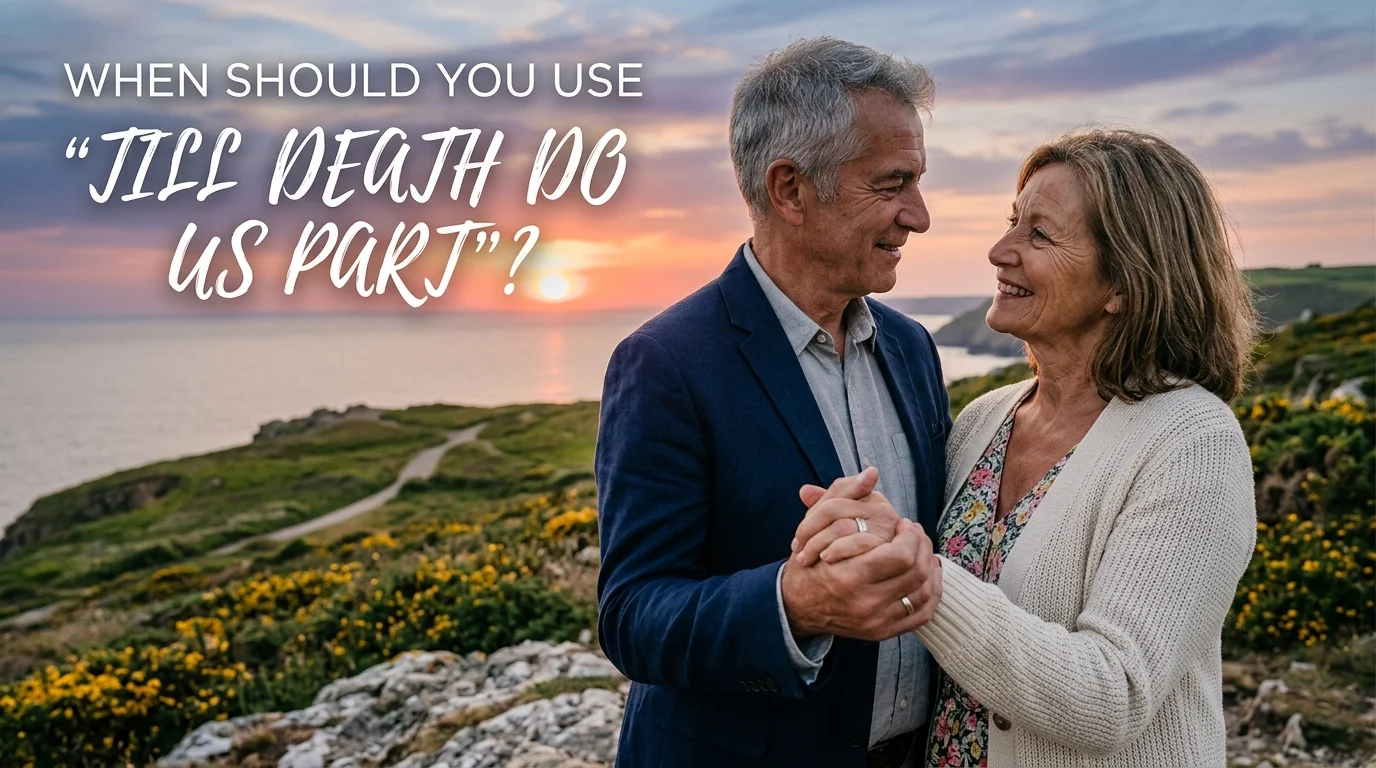
“Till death do us part” is most appropriate when the context is explicitly about marriage, lifelong commitment, or traditional wedding language. Its meaning is immediately recognizable to many English speakers, which makes it effective when a solemn or traditional tone is intended.
Professional settings
The phrase is rarely necessary in ordinary workplace communication. It may appear in professional writing when discussing:
- Marriage ceremonies
- Literature
- Religion
- Cultural traditions
- Historical language
- Films or popular culture
- Relationship-related content
For example, a wedding planner could write:
“Many couples still choose traditional vows, including the familiar promise to remain together till death do us part.”
In a business email, however, a phrase such as “for the duration of the partnership” would normally be clearer and more appropriate.
Casual conversations
The phrase can work in conversation when discussing marriage, relationships, or humorously describing an unusually strong attachment.
“They’ve been together for thirty years—truly, till death do us part.”
Because the wording is recognizable, it can also be used playfully.
Writing, presentations, and digital communication
It works particularly well in:
- Wedding speeches
- Wedding invitations
- Relationship articles
- Personal essays
- Fiction
- Historical discussions
- Social media captions
- Discussions of traditional wedding vows
When it is especially effective
Use it when you deliberately want solemnity, permanence, tradition, or emotional weight. If your goal is a relaxed, modern, inclusive, or conversational tone, a simpler alternative may communicate the same basic idea more naturally.
When Should You Avoid “Till Death Do Us Part”?
There are situations where the phrase can create unnecessary formality or ambiguity.
Overly formal situations
The wording can sound dramatic in ordinary professional or personal communication. Saying:
“We will continue working together till death do us part”
may sound humorous or theatrical unless that effect is intentional.
Legal, academic, or sensitive contexts
Avoid relying on the phrase when precision is important. In legal or academic writing, specify the actual relationship, duration, condition, or obligation instead.
For example, “for the duration of the agreement” is more precise than a phrase suggesting lifelong commitment.
Situations where nuance may be lost
The phrase describes an extremely strong, permanent commitment. It may therefore be inappropriate if you only mean:
- Long-term cooperation
- Continued friendship
- Ongoing support
- A temporary commitment
- A relationship that may reasonably change
It can also feel uncomfortable in conversations involving separation, divorce, bereavement, or relationship difficulties.
Is “Till Death Do Us Part” Professional, Polite, or Casual?
“Till death do us part” is primarily traditional and solemn rather than professional or casual. Its strongest association is with marriage vows.
Its formality comes from its historical connection with religious wedding ceremonies and older English. The emotional subtext is equally important: it suggests loyalty, permanence, seriousness, and a willingness to remain committed despite difficulties.
In a workplace, the expression may be interpreted as:
- Dramatic
- Humorous
- Figurative
- Unusually personal
- Intentionally memorable
In a wedding, however, it can sound completely natural.
The audience also matters. A traditional wedding ceremony may make the phrase feel appropriate, while a modern secular ceremony may favor “for the rest of our lives” or “for as long as we both shall live.”
Pros and Cons of Using “Till Death Do Us Part”
Advantages
- Clarity: Most English speakers understand the basic idea immediately.
- Efficiency: Four familiar words communicate a powerful lifelong commitment.
- Accessibility: The expression is widely recognized across English-language culture.
- Emotional impact: It carries strong associations with marriage, loyalty, and permanence.
- Cultural familiarity: Many readers recognize it from traditional wedding vows.
Potential Drawbacks
- Oversimplification: It can make a complex relationship sound completely absolute.
- Tone mismatch: It may sound too solemn or old-fashioned in modern casual communication.
- Repetition: Frequent use in wedding-related content can make writing feel predictable.
- Cultural sensitivity: Some audiences may associate it strongly with religious marriage traditions.
- Emotional intensity: The reference to death may feel uncomfortable in certain settings.
Real-Life Examples of “Till Death Do Us Part” by Context
Emails
A wedding-related email can use the phrase naturally:
“Thank you for helping us create a ceremony that feels personal while still honoring the traditional ‘till death do us part’ vows.”
In a normal business email, the expression would usually be unnecessary.
Meetings
In a meeting about a wedding event, someone might say:
“The couple wants the ceremony to feel modern, but they still want to include ‘till death do us part.’”
Used in another professional meeting, the phrase could sound deliberately humorous.
Presentations
A presentation about language and culture might say:
“The phrase ‘till death do us part’ illustrates how religious wedding language became part of everyday English.”
Conversations
A friend might say:
“They’ve been married since college. They really meant ‘till death do us part.’”
Social media
A couple celebrating an anniversary might write:
“Another year together, and still grateful for the promise we made: till death do us part. ❤️”
Here, the phrase works because the emotional and romantic context is clear.
“Till Death Do Us Part” vs Similar Expressions (Key Differences)
| Phrase | Meaning Difference | Tone Difference | Best Use Scenario |
| For the rest of our lives | Clearly means throughout both people’s remaining lives | Modern, warm, natural | Personal vows and anniversary messages |
| For as long as we both shall live | Expresses the same lifelong commitment in a slightly more formal form | Traditional and solemn | Wedding ceremonies |
| Together for life | Emphasizes lifelong togetherness without mentioning death | Simple and contemporary | Wedding captions and personal writing |
| A lifelong commitment | Focuses on the commitment rather than the emotional vow | Neutral and polished | Articles, presentations, and formal writing |
| Forever together | Suggests permanent togetherness but can be less literal | Romantic and informal | Social media and personal messages |
| Through thick and thin | Emphasizes staying supportive through difficulties rather than specifically lasting until death | Warm, idiomatic, conversational | Relationships and friendships |
Meaning differences
“Till death do us part” is specifically associated with a lifelong marital promise. “Through thick and thin” focuses more on loyalty during difficult circumstances. “A lifelong commitment” is broader and can describe marriage, caregiving, professional dedication, or other long-term obligations.
Tone differences
Traditional alternatives such as “for as long as we both shall live” retain the solemn character of the original. Modern alternatives such as “together for life” feel lighter and more conversational.
Best-use scenarios
For a wedding ceremony, traditional wording may fit naturally. For an anniversary caption, “forever together” may sound warmer. For an article, “lifelong commitment” may be clearer and more neutral.
Common Mistakes & Misuse of “Till Death Do Us Part”
Overuse
Using the phrase repeatedly can make relationship writing sound formulaic. If several paragraphs discuss marriage, alternate naturally with expressions such as “lifelong commitment,” “for the rest of their lives,” or “together for life.”
Incorrect context
The phrase is strongly associated with marriage. Applying it to ordinary friendships, business partnerships, or minor commitments can sound exaggerated unless humor is intended.
Contradictory usage
Avoid combining it with wording that clearly limits the commitment.
For example:
“We promised to stay together till death do us part, at least for the next two years.”
The contradiction makes the sentence confusing unless it is deliberately humorous.
Cultural misunderstandings
Not every audience interprets the phrase in the same way. Some people hear traditional Christian wedding language; others simply hear a familiar romantic expression. When cultural or religious context matters, choose wording that makes your intended meaning clear.
Psychological Reasons People Prefer “Till Death Do Us Part”
The phrase remains memorable partly because it communicates a complex idea in a compact form.
Cognitive load reduction
People remember familiar phrases more easily than lengthy explanations. Instead of explaining that two people intend to remain married throughout their lives, the phrase communicates that concept quickly.
Trust and authority signals
Traditional language can create a sense of seriousness and commitment. In a wedding ceremony, familiar wording may reassure listeners because it connects the present event with a long-established social tradition.
Attention economy
Modern readers encounter enormous amounts of content every day. Familiar expressions can attract attention because people recognize them quickly. A phrase like “till death do us part” carries cultural associations without requiring much explanation.
Modern communication habits
Short-form communication has increased the value of concise expressions. Couples may use a shortened or adapted version in social media posts, captions, and messages because the phrase communicates emotional intensity efficiently.
However, familiarity can also create a drawback: because the expression is so recognizable, it may feel conventional rather than personal. Modern writers often modify it to make a message sound more individual.
US vs UK Usage of “Till Death Do Us Part”
The expression is understood in both American and British English. There is no major difference in its core meaning.
Popularity
The phrase has strong historical associations with British Anglican wedding traditions, but it became widely familiar in American English through religion, literature, entertainment, and popular culture.
Tone perception
British readers may be especially familiar with the historical wording “till death us do part,” while American readers commonly recognize both that traditional form and the modernized “till death do us part.”
In both varieties, the expression generally sounds traditional, solemn, romantic, or dramatic.
Regional preferences
Modern speakers in both the US and UK may prefer clearer everyday alternatives such as:
- For the rest of our lives
- Together for life
- Forever together
- For as long as we both shall live
The choice is more strongly influenced by age, religious background, ceremony style, and personal preference than by a strict US-versus-UK distinction.
“Till Death Do Us Part” in Digital & Modern Communication
Emails
Use it sparingly in personal or wedding-related emails. It is generally too dramatic for routine professional correspondence.
Slack / WhatsApp
In messaging apps, it can work as a joke:
“This project and I are together till death do us part.”
The humor comes from applying a marriage vow to an ordinary situation.
Social media
The phrase is especially common in anniversary posts, wedding captions, engagement announcements, and romantic content. Emojis and informal language can make the traditional phrase feel more contemporary.
AI-generated summaries
AI-generated writing may use the phrase because it is a familiar expression for lifelong commitment. However, writers should check whether it genuinely matches the source material. If the original text simply says that two people have a long-term relationship, automatically upgrading it to “till death do us part” can exaggerate the meaning.
For high-quality writing, AI-generated language should preserve the actual degree of commitment rather than selecting the most dramatic synonym.
Linguistic & Communication Insight
Emotional weight & subtext
Native English speakers generally understand more than the literal meaning when they hear “till death do us part.” The expression can suggest loyalty, permanence, marriage, tradition, seriousness, and emotional devotion.
The reference to death gives the expression unusually strong emotional weight. This is one reason it feels more intense than “we’ll be together for a long time.”
Direct vs indirect phrasing
The phrase is direct about permanence. It does not leave much uncertainty about the intended duration of the commitment.
Compare:
“We’ll stay together for as long as we can.”
with:
“Till death do us part.”
The first statement leaves room for uncertainty. The second communicates an absolute lifelong intention.
A softer alternative such as “I hope we’ll share many more years” may be more appropriate when the speaker wants warmth without sounding absolute.
Professional communication perspective
In professional settings, the phrase can be memorable but should be used intentionally. A manager saying:
“We’re committed to this partnership till death do us part”
could sound humorous, exaggerated, or overly personal.
A more professional version would be:
“We’re committed to building a long-term partnership.”
The second sentence communicates commitment without importing the emotional associations of marriage.
Pragmatic reasons for alternatives
Experienced communicators often choose alternatives because they want to control the emotional temperature of a message.
“Lifelong commitment” sounds polished and neutral.
“Together for life” sounds warm and personal.
“For the rest of our lives” sounds straightforward and modern.
“Through thick and thin” emphasizes resilience rather than permanence.
Choosing among them allows the writer to communicate the intended idea without creating unnecessary emotional pressure.
Social signaling
Word choice tells readers how they should interpret a message. Traditional wedding language can signal respect for ceremony and heritage. Contemporary wording can signal simplicity, individuality, or informality.
This is why there is no single “best” synonym. The strongest alternative is the one that matches the intended relationship, audience, and communication setting.
Tone & context guidance
Use “till death do us part” when permanence and tradition are central to the message. Consider a softer alternative when the audience may find references to death uncomfortable or when the relationship does not involve marriage.
For professional, academic, and legal communication, replace emotional wording with precise language describing the actual commitment or duration.
Conclusion
“Till death do us part” remains one of the most recognizable expressions of lifelong commitment in English. Traditionally associated with marriage vows, the phrase communicates permanence, loyalty, devotion, and the intention to remain together throughout life. Its historical connection to wedding ceremonies gives it a solemn and traditional tone, while its continued use in modern culture keeps it familiar to English speakers.
However, the best alternative depends on context, audience, and the emotional effect you want to create. “For the rest of our lives” offers a modern and natural option, while “a lifelong commitment” sounds more neutral and polished. “Together for life” feels simple and contemporary, whereas “through thick and thin” emphasizes loyalty during difficult times rather than lifelong duration.
Understanding these differences helps writers, students, professionals, and ESL learners communicate more precisely. Instead of choosing a synonym simply because it has a similar dictionary meaning, consider whether you want to express tradition, romance, reassurance, permanence, or resilience. The right phrase should match both the message and the audience.
FAQs
What does “till death do us part” mean?
“Till death do us part” means that two married people promise to remain together and committed to each other for the rest of their lives. It traditionally appears in wedding vows and expresses lifelong devotion. The phrase is strongly associated with marriage, permanence, loyalty, and a serious commitment between spouses.
What is another way to say “till death do us part”?
Common alternatives include “for the rest of our lives,” “together for life,” “a lifelong commitment,” “forever together,” and “for as long as we both shall live.” The best alternative depends on tone. “For the rest of our lives” sounds modern, while “for as long as we both shall live” retains a traditional, ceremonial feel.
Is “till death do us part” grammatically correct?
Yes. “Till death do us part” is a traditional and grammatically established expression. Its unusual word order comes from older forms of English. Modern speakers might naturally say “until death parts us,” but the traditional wording remains widely recognized because of its long association with wedding ceremonies and marriage vows.
Is “till death do us part” formal or informal?
The phrase is best described as traditional and solemn rather than simply formal or informal. It is natural in wedding ceremonies, romantic writing, and discussions of marriage. In everyday conversation or professional communication, it may sound dramatic, old-fashioned, or humorous depending on the context and relationship between the speakers.
Can “till death do us part” be used outside marriage?
Yes, but usually figuratively or humorously. The expression is strongly connected with marriage, so using it for a friendship, hobby, job, or business relationship creates an intentionally dramatic effect. For example, someone might jokingly say, “Coffee and I are together till death do us part,” to emphasize a strong attachment.
What is the modern version of “till death do us part”?
There is no single official modern replacement, but “for the rest of our lives” is one of the closest contemporary alternatives. It preserves the idea of lifelong commitment without directly mentioning death. “Together for life” is another concise option that sounds more casual, modern, and suitable for social media or personalized wedding vows.
Is “till death do us part” romantic?
Yes, it can sound highly romantic because it expresses lifelong loyalty and devotion. However, its emotional effect depends on the audience and context. Some people find the traditional wording meaningful and powerful, while others consider it old-fashioned or overly serious. Modern alternatives can preserve the romantic meaning while creating a softer tone.
What is the difference between “till death do us part” and “forever together”?
Both expressions suggest lasting togetherness, but they differ in tone and specificity. “Till death do us part” is closely associated with marriage vows and explicitly refers to the end of life. “Forever together” is broader, shorter, and more informal, making it common in romantic messages, anniversary posts, and social media captions.
Is “till death do us part” American or British English?
The phrase is used and understood in both American and British English. Its historical roots are strongly connected with British wedding traditions, particularly Anglican marriage language. However, American English speakers are also highly familiar with it through weddings, literature, television, films, and popular culture. Regional differences are relatively small compared with differences in tone and context.
Why does “till death do us part” sound so powerful?
The phrase combines several strong ideas in very few words: marriage, lifelong commitment, loyalty, permanence, and death. Its long history in wedding ceremonies also gives it cultural familiarity. Because of these associations, it usually sounds more emotionally intense and solemn than alternatives such as “together for life” or “for the rest of our lives.”

