
Imagine a coworker has made a small mistake, a friend is apologizing for bringing you an inexpensive gift, or someone is turning a minor inconvenience into a lengthy discussion. You might naturally say, “Don’t make a fuss.” The expression is familiar, but its tone can change significantly depending on who says it, how it is delivered, and what situation surrounds it.
“Don’t make a fuss” generally means not to complain, overreact, create unnecessary attention, or treat a relatively minor matter as if it were a major problem. It can also reassure someone that they do not need to make special arrangements or feel embarrassed about something.
Because the expression can sound warm in one situation and dismissive in another, choosing the right alternative matters. In professional communication, for example, “There’s no need to worry about it” may sound more supportive, while “Let’s keep this simple” can be more neutral and collaborative. Understanding these distinctions helps professionals, students, ESL learners, and content writers communicate with greater precision.
What Does “Don’t Make A Fuss” Mean?

“Don’t make a fuss” means not to complain, become overly concerned, create unnecessary attention, or treat a minor issue as a serious problem. It is commonly used when someone is reacting strongly to a small inconvenience, offering excessive help, apologizing repeatedly, or making more preparation than necessary. Depending on context, it can sound reassuring, practical, impatient, or mildly dismissive.
Simple Meaning
In plain English, “don’t make a fuss” means “don’t make this into a bigger issue than it needs to be.”
The expression can communicate several closely related ideas:
- Don’t overreact.
- Don’t complain unnecessarily.
- Don’t make a scene.
- Don’t worry about giving me special treatment.
- Don’t go to unnecessary trouble.
- Don’t draw too much attention to this.
The intended meaning depends heavily on context.
For example:
“Thanks for offering to drive me home, but don’t make a fuss. I can take the bus.”
Here, the speaker means that the other person does not need to go to extra trouble.
But:
“It was only a small delay. Don’t make a fuss.”
Here, the speaker is asking someone not to overreact or complain.
That difference is important because the same phrase can either reduce tension or make someone feel dismissed.
Origin & History of “Don’t Make A Fuss”
The key word in this expression is “fuss.” English has used fuss for a long time to describe unnecessary excitement, agitation, complaint, or excessive concern.
The precise origin of fuss is uncertain. It appears in English in the eighteenth century, with early uses associated with unnecessary activity, disturbance, complaint, or agitation. Linguists and dictionaries generally treat its etymology as uncertain rather than attributing it confidently to one particular source.
The expression “make a fuss” developed around the idea of creating unnecessary disturbance or attention. From there, “don’t make a fuss” became a natural way to tell someone not to exaggerate a situation or make unnecessary trouble.
Over time, the phrase developed two especially common meanings:
- Do not complain or overreact.
- Do not go to unnecessary trouble or make special arrangements.
This second meaning is particularly noticeable in British English:
“Please don’t make a fuss over me. I’m perfectly happy with whatever you’re having.”
The phrase remains common in contemporary English, including workplace conversations, family interactions, customer service, emails, and informal digital communication.
Synonyms & Alternatives by Tone
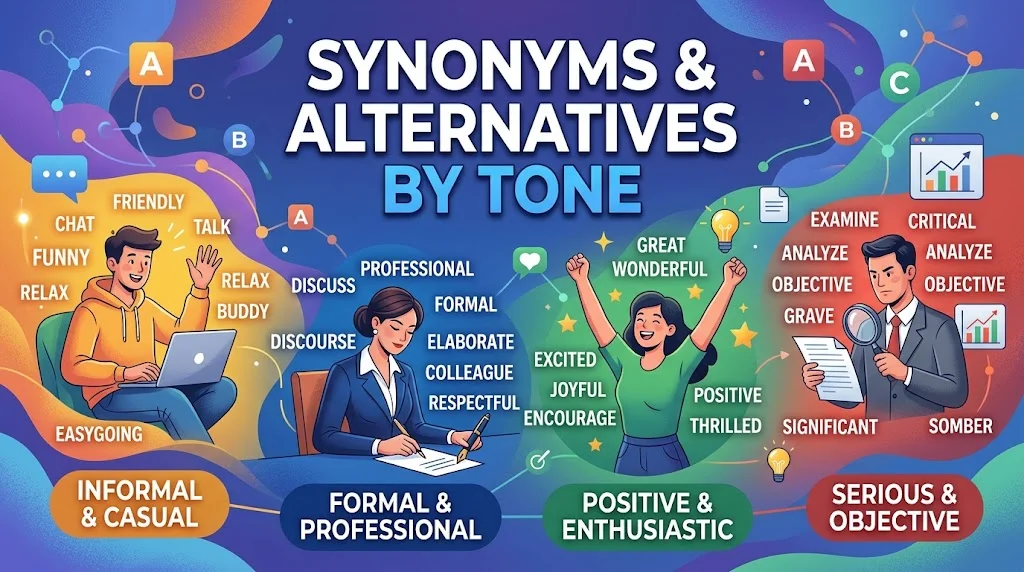
There is no single perfect synonym for “don’t make a fuss.” The best alternative depends on whether you want to sound professional, reassuring, casual, direct, or playful.
Professional & Neutral Alternatives
- Let’s keep this simple.
- There’s no need to make a big deal of it.
- Let’s not overcomplicate things.
- There’s no need for special arrangements.
- Please don’t go to any extra trouble.
Polite & Supportive Alternatives
- There’s no need to worry about it.
- It’s really not a problem.
- Please don’t trouble yourself.
- You don’t need to go out of your way.
- No need to worry about that.
Encouraging & Reassuring Alternatives
- It’s okay.
- Don’t worry about it.
- It’s nothing serious.
- No big deal.
- Everything is fine.
Casual, Playful & Idiomatic Alternatives
- Don’t make a big thing of it.
- Don’t make a scene.
- Don’t get worked up.
- No need for all that.
- Keep it low-key.
The important distinction is that some alternatives focus on complaining, others on worry, and others on unnecessary effort or attention.
When Should You Use “Don’t Make A Fuss”?
“Don’t make a fuss” works best when the situation is relatively minor, and the speaker wants to prevent unnecessary concern, attention, effort, or emotional escalation.
Professional Settings
In the workplace, the phrase can work in relaxed relationships where the speaker and listener already have a comfortable rapport.
For example:
“Thanks for offering to arrange lunch, but don’t make a fuss. I’m happy with whatever is available.”
However, a more neutral alternative is often preferable when speaking to a client, senior executive, unfamiliar colleague, or external partner.
Casual Conversations
This is one of the expression’s strongest contexts.
“Don’t make a fuss about dinner. We can just order something.”
It sounds natural among friends, relatives, and people who know each other well.
Writing, Presentations, and Digital Communication
The phrase can appear naturally in emails, messages, blogs, social media posts, and conversational writing. However, its informal character means it should not automatically replace more precise professional language.
When It Is Especially Effective
Use it when you want to communicate that:
- a problem is relatively minor;
- someone does not need to worry;
- excessive preparation is unnecessary;
- a person is apologizing too much;
- attention is being drawn to something unnecessarily;
- the situation does not require dramatic action.
When Should You Avoid “Don’t Make A Fuss”?
Although common and understandable, the expression is not suitable for every situation.
Overly Formal Situations
In formal business writing, “There is no need for additional arrangements” may be clearer than “Don’t make a fuss.”
Legal, Academic, or Sensitive Contexts
Avoid using the phrase when precision is critical.
For example, telling someone “Don’t make a fuss” about a workplace complaint, safety concern, legal issue, or serious personal problem could appear dismissive.
Situations Where Nuance May Be Lost
If someone is genuinely upset, frightened, or dealing with a serious issue, the phrase may minimize their experience.
Instead of:
“Don’t make a fuss about the problem.”
consider:
“I understand why you’re concerned. Let’s work through it.”
The second version acknowledges the person’s feelings before addressing the practical issue.
Is “Don’t Make A Fuss” Professional, Polite, or Casual?
“Don’t make a fuss” is generally conversational and informal-to-neutral rather than strongly formal. It can be polite when used warmly, but it can also sound dismissive when directed at someone who believes an issue deserves attention.
Tone Analysis
The expression may communicate:
- Reassurance: “Don’t make a fuss—I’m perfectly fine.”
- Practicality: “Don’t make a fuss; we can solve this easily.”
- Impatience: “Don’t make a fuss over something so small.”
- Dismissiveness: “Don’t make a fuss about the complaint.”
- Humility: “Please don’t make a fuss over my promotion.”
Emotional Subtext
Native speakers often interpret more than the literal words. The listener may ask:
Is the speaker calming me down, or telling me that my concern does not matter?
That distinction comes largely from voice, relationship, and context.
Pros and Cons of Using “Don’t Make A Fuss”
Advantages
Clarity: The expression quickly communicates that unnecessary concern or attention is not wanted.
Efficiency: It is short and familiar, making it useful in everyday conversations.
Accessibility: Most fluent English speakers understand it without explanation.
Naturalness: It sounds conversational rather than scripted.
Potential Drawbacks
Oversimplification: It may make a legitimate concern sound insignificant.
Tone mismatch: It can feel too casual in formal or sensitive settings.
Perceived dismissal: Someone who is genuinely worried may feel that their concern is being ignored.
Ambiguity: It can refer to complaining, worrying, overreacting, or going to unnecessary trouble.
Real-Life Examples of “Don’t Make A Fuss” by Context
“Thanks for offering to send a replacement immediately. Please don’t make a fuss—I’m happy to wait until the next shipment.”
This use is polite because the speaker is declining extra effort.
Meeting
“We only need to move the meeting by fifteen minutes, so don’t make a fuss. I’ll update the calendar.”
Here, the phrase signals that the change is minor.
Presentation
“If the slide has a small formatting issue, don’t make a fuss. We can correct it after the presentation.”
The expression reduces attention to a minor problem.
Conversation
“You forgot the dessert? Don’t make a fuss. We have plenty of food.”
This is reassuring and informal.
Social Media
“The first version wasn’t perfect, but don’t make a fuss—we fixed it, and the updated version is live.”
The phrase gives the post a relaxed, conversational tone.
“Don’t Make A Fuss” vs Similar Expressions: Key Differences
These expressions overlap, but they do not always communicate the same intention.
| Phrase | Meaning Difference | Tone Difference | Best Use Scenario |
| Don’t make a big deal of it | Do not treat something as unusually important | Casual, direct | Minor problems or mistakes |
| Don’t make a scene | Do not attract public attention through disruptive behavior | More forceful | Public arguments or emotional reactions |
| Don’t get worked up | Do not become excessively angry, worried, or emotional | Casual, somewhat direct | Emotional reactions |
| Don’t worry about it | The person does not need to be concerned | Supportive and reassuring | Mistakes, favors, minor problems |
| Don’t trouble yourself | Do not make extra effort for the speaker | Polite, somewhat traditional | Offers of help or unnecessary arrangements |
| Let’s keep this simple | Avoid unnecessary complexity rather than unnecessary emotion | Professional and collaborative | Meetings, projects, decisions |
The main distinction is what the speaker wants to reduce. “Don’t make a fuss” can reduce attention, complaint, effort, or emotional reaction. The alternatives tend to target one of these meanings more specifically.
Common Mistakes & Misuse of “Don’t Make A Fuss”
Overuse
Using the expression every time someone raises a concern can make you sound impatient.
If a colleague repeatedly raises a genuine issue and you respond with “Don’t make a fuss,” they may feel that you are unwilling to listen.
Incorrect Context
The phrase is inappropriate when a matter is genuinely serious.
For example, a health, safety, financial, legal, or workplace harassment concern should not automatically be described as something that does not deserve attention.
Contradictory Usage
Avoid saying:
“Don’t make a fuss, but this is actually a very serious problem.”
The two ideas conflict unless you clearly mean that the person should remain calm while the issue is being addressed.
Cultural Misunderstandings
Learners of English sometimes interpret “fuss” as simply meaning “worry.” In reality, it can also involve complaining, unnecessary attention, commotion, or extra effort.
Understanding that broader meaning helps ESL learners choose more accurate alternatives.
Psychological Reasons People Prefer “Don’t Make A Fuss”
People often prefer short expressions because they reduce the amount of explanation needed in everyday communication.
Cognitive Load Reduction
A familiar phrase can communicate a complicated social instruction quickly. Instead of explaining, “There is no reason to devote additional attention or effort to this minor matter,” someone can simply say:
“Don’t make a fuss.”
Trust and Authority Signals
With the right relationship, a concise expression can signal confidence. The speaker appears to believe the situation is manageable.
However, authority can easily become dismissiveness if the listener does not share that assessment.
Attention Economy
Modern communication is fast. People often prefer language that tells others immediately whether something requires attention.
“Don’t make a fuss” efficiently communicates:
This does not need more attention than it is already receiving.
Modern Communication Habits
Short expressions work especially well in messaging platforms where people favor quick, conversational exchanges.
The risk is that text removes vocal cues. A phrase that sounds affectionate when spoken may look blunt in a message.
US vs UK Usage of “Don’t Make A Fuss”
“Don’t make a fuss” is understood in both American and British English. It is not restricted to one variety of English.
In both regions, it can describe unnecessary complaint, attention, emotional reaction, or effort.
There can, however, be differences in perceived frequency and conversational style. British English makes particularly comfortable use of expressions involving “fuss” and “make a fuss,” including contexts where someone is being given too much attention or where excessive effort is being made.
American English speakers also use the phrase naturally, although alternatives such as “don’t make a big deal out of it,” “don’t make a scene,” or “don’t worry about it” may be preferred depending on the situation.
The safest approach is to focus on meaning and context rather than assuming a strict US-versus-UK rule.
“Don’t Make A Fuss” in Digital & Modern Communication
Emails
In a friendly workplace email, the expression can soften a refusal of extra assistance:
“Thanks for offering to resend everything. Don’t make a fuss—I can access the original files.”
For formal business communication, a more neutral option may be better.
Slack / WhatsApp
The phrase works naturally in informal messaging:
“No worries about being five minutes late. Don’t make a fuss—we’re still setting up.”
Social Media
It can give posts a relaxed and personable tone, particularly when discussing minor mistakes or inconveniences.
AI-Generated Summaries
When AI-generated writing explains this phrase, it should preserve the distinction between not overreacting, not complaining, and not going to unnecessary trouble. Treating “don’t make a fuss” as simply meaning “don’t worry” loses part of its practical meaning.
Linguistic & Communication Insight
Emotional Weight & Subtext
The literal message is straightforward, but the social meaning can be more complicated.
When someone says:
“Don’t make a fuss.”
the listener may hear:
- “This isn’t important.”
- “You don’t need to worry.”
- “Please don’t make this public.”
- “You don’t need to do anything special for me.”
- “You’re reacting more strongly than necessary.”
The surrounding context determines which interpretation feels most natural.
Direct vs Indirect Phrasing
“Don’t make a fuss” is relatively direct because it tells the listener what not to do.
Compare:
“Don’t make a fuss.”
with:
“I think we can keep this fairly simple.”
The first places the behavioral instruction directly on the listener. The second frames the solution collaboratively.
Similarly:
“Don’t get worked up.”
focuses on emotional control, while:
“There’s no need to worry.”
focuses on reassurance.
Choosing among them requires understanding the actual communication goal.
Professional Communication Perspective
In professional settings, the expression can be useful among colleagues who have an established relationship. However, it deserves caution with clients, customers, senior leaders, unfamiliar colleagues, or people raising legitimate concerns.
A workplace communicator may choose:
“Let’s keep this simple.”
instead of:
“Don’t make a fuss.”
The first sounds more collaborative because it uses “let’s” rather than directly instructing another person.
Pragmatic Reasons for Alternatives
Experienced communicators often replace “don’t make a fuss” because they want to reduce defensiveness.
For example:
“There’s no need to worry about it.”
sounds more supportive than:
“Don’t make a fuss.”
Similarly:
“Please don’t go to any extra trouble.”
clearly communicates that the speaker appreciates the offer but does not need additional effort.
Social Signaling
Word choice tells people how seriously you are taking them.
Using “don’t make a fuss” may signal confidence and informality, but it can also signal that you believe the listener’s reaction is excessive.
Using “I understand why you’re concerned” sends a different social signal: the speaker recognizes the listener’s perspective before addressing the issue.
Tone & Context Guidance
Use “don’t make a fuss” when the relationship is comfortable and the matter is genuinely minor.
Choose something softer when the person may already feel embarrassed, worried, or vulnerable.
Choose something more precise when you are communicating professionally or discussing an issue that could have meaningful consequences.
Meaning, Usage & Examples for Each Alternative
No Need to Make a Big Deal of It
Meaning: This means the situation should not be treated as unusually important, serious, or dramatic.
Why This Phrase Works: It closely matches one of the central meanings of “don’t make a fuss” while making the idea of exaggeration clearer.
Real-World Usage Insight: It is especially natural when someone is worrying about a small mistake or giving too much attention to an ordinary event.
Best Use: Casual workplace conversations, messages, conversations with friends, and minor mistakes.
Avoid When: A person is raising a legitimate serious concern.
Tone: Casual, direct, and reassuring.
US vs UK Usage: Common and easily understood in both varieties, with “make a big deal out of it” also particularly familiar in American English.
Example (Email / Message / Meeting): “The client only asked us to adjust one sentence, so there’s no need to make a big deal of it. I’ll update the draft.”
Don’t Make a Big Thing of It
Meaning: This means do not treat a relatively minor matter as more important than it really is.
Why This Phrase Works: It is one of the closest informal alternatives because it preserves the idea of unnecessary attention or emotional reaction.
Real-World Usage Insight: It sounds particularly natural when someone is embarrassed about a small mistake or event.
Best Use: Friendly conversations and informal workplace communication.
Avoid When: Writing highly formal business correspondence.
Tone: Informal, conversational, reassuring.
US vs UK Usage: Widely understood, with the wording feeling especially natural in British and international English.
Example (Email / Message / Meeting): “Thanks for remembering my birthday, but honestly, don’t make a big thing of it. A quick coffee is more than enough.”
Don’t Make a Scene
Meaning: This means do not create a public disturbance or draw unwanted attention through an emotional or disruptive reaction.
Why This Phrase Works: It is useful when “fuss” specifically means public commotion rather than unnecessary effort.
Real-World Usage Insight: It is much stronger than simply telling someone not to worry.
Best Use: Public disagreements, arguments, or situations where someone is becoming visibly disruptive.
Avoid When: Someone is quietly expressing a reasonable concern.
Tone: Direct, firm, and sometimes confrontational.
US vs UK Usage: Common in both American and British English.
Example (Email / Message / Meeting): “If the restaurant has made a mistake with the reservation, let me speak to the manager. There’s no reason to make a scene.”
Don’t Get Worked Up
Meaning: This means do not become excessively angry, anxious, or emotionally upset about something.
Why This Phrase Works: It focuses specifically on emotional escalation.
Real-World Usage Insight: Unlike “don’t make a fuss,” this expression is mainly about a person’s emotional state rather than unnecessary effort or attention.
Best Use: Casual conversations when someone is becoming visibly frustrated or anxious.
Avoid When: You need a formal or highly sensitive response.
Tone: Casual and direct.
US vs UK Usage: Common in both varieties of English.
Example (Email / Message / Meeting): “Don’t get worked up about the delayed report. We have enough time to fix the formatting before it goes out.”
Don’t Worry About It
Meaning: This tells someone that they do not need to feel concerned about a problem, mistake, favor, or inconvenience.
Why This Phrase Works: It is softer and more reassuring than many alternatives.
Real-World Usage Insight: It is often the safest everyday substitute when the intended message is simply reassurance.
Best Use: Apologies, small mistakes, favors, delays, and everyday conversations.
Avoid When: You actually need the person to take corrective action.
Tone: Warm, supportive, and casual.
US vs UK Usage: Extremely common in both American and British English.
Example (Email / Message / Meeting): “Don’t worry about it. The attachment came through correctly, and I’ve already added it to the project folder.”
Conclusion
“Don’t Make A Fuss” is a common English expression used to tell someone not to make a situation seem more complicated, dramatic, or troublesome than it needs to be. Depending on the context and relationship between speakers, it can sound reassuring, practical, humorous, or slightly dismissive. Understanding this difference is important because the phrase may be friendly among close friends but less appropriate in sensitive or professional situations.
Alternatives such as “No need to worry,” “It’s not a big deal,” “Please don’t worry about it,” or “Let’s keep things simple” can communicate a similar idea with a softer tone. For ESL learners, professionals, students, and content writers, choosing the right alternative depends on the situation, the listener, and the level of formality required. By understanding its meaning, tone, synonyms, and appropriate usage, you can use “Don’t Make A Fuss” naturally while avoiding unintended offense or misunderstanding.
FAQs
What does “Don’t Make A Fuss” mean?
“Don’t Make A Fuss” means do not make a situation seem more serious, difficult, or important than it is. It can also mean not to complain, protest, or create unnecessary attention. The expression is commonly used in informal conversations and may sound friendly, reassuring, impatient, or dismissive depending on the speaker’s tone and context.
Is “Don’t Make A Fuss” rude?
“Don’t Make A Fuss” is not automatically rude, but it can sound dismissive depending on how it is said. With friends or family, it may be a casual way to reassure someone. In professional or sensitive situations, softer alternatives such as “Please don’t worry” or “There’s no need to be concerned” may be more appropriate.
What is another way to say “Don’t Make A Fuss”?
Common alternatives include “Don’t worry about it,” “It’s not a big deal,” “No need to make a big deal of it,” “Please don’t trouble yourself,” and “Let’s keep things simple.” The best alternative depends on the situation. Some expressions sound casual, while others are more polite, professional, or reassuring.
What is a polite way to say “Don’t Make A Fuss”?
A polite alternative is “Please don’t worry about it” because it reassures the listener without directly criticizing their reaction. Other options include “There’s no need to worry,” “Please don’t go to any trouble,” and “It’s really not a problem.” These choices work better when you want to sound considerate and respectful.
Can “Don’t Make A Fuss” be used professionally?
Yes, but it should be used carefully. “Don’t Make A Fuss” is generally informal and can sometimes sound dismissive in workplace communication. In professional settings, alternatives such as “There’s no need for concern,” “Please don’t worry about it,” or “Let’s keep this straightforward” are usually clearer, more neutral, and more respectful.
Is “Don’t Make A Fuss” an idiom?
Yes. “Don’t Make A Fuss” is an idiomatic expression because its meaning goes beyond the literal meaning of the individual words. It generally tells someone not to complain, protest, become overly concerned, or draw unnecessary attention to a situation. Its exact meaning can vary slightly depending on the context and speaker’s tone.
What does “make a fuss” mean?
“To make a fuss” means to react strongly to something, often by complaining, protesting, showing excessive concern, or attracting unnecessary attention. For example, if someone complains repeatedly about a minor inconvenience, another person might say, “There’s no need to make a fuss.” The phrase is usually associated with informal English.
What are the synonyms of “Don’t Make A Fuss”?
Useful synonyms include “Don’t worry,” “Calm down,” “It’s not a big deal,” “Don’t make a big deal of it,” “No need to complain,” “Please don’t trouble yourself,” and “Let’s not overcomplicate things.” These alternatives are not always interchangeable, so choose one according to whether you want to sound reassuring, casual, polite, or firm.
What is the opposite of “Don’t Make A Fuss”?
The opposite would be encouraging someone to express concern, complain, or give a situation more attention. Expressions such as “Speak up,” “Make your concerns known,” “Don’t ignore the problem,” or “Make a point of addressing it” can convey the opposite idea. The best choice depends on whether the context involves emotions, complaints, or a practical problem.
When should you avoid saying “Don’t Make A Fuss”?
Avoid saying “Don’t Make A Fuss” when someone is discussing a serious concern, expressing genuine distress, or raising an important workplace issue. The phrase may unintentionally minimize their feelings or concerns. In these situations, empathetic alternatives such as “I understand why you’re concerned” or “Let’s talk about what happened” are usually more appropriate.

