
Imagine a colleague explains why a project missed its target, but their explanation completely misses what actually happened. You might naturally respond, “That is not it at all.” The sentence tells the listener that their interpretation is substantially or completely incorrect. However, the phrase can sound firm, dismissive, or even confrontational depending on the situation.
Understanding “that is not it at all” is therefore about more than knowing its dictionary meaning. The wording, tone, relationship between speakers, and communication channel all affect how the message is received. In professional emails, meetings, classrooms, conversations, and online discussions, alternatives such as “That’s not quite right,” “That’s not what I meant,” or “That’s not the main issue” can communicate the same basic correction with a different level of directness.
This guide explains the meaning, history, synonyms, tone, practical usage, and communication nuances of “that is not it at all.” It also provides realistic alternatives for professionals, students, ESL learners, writers, and anyone who wants to correct a misunderstanding without creating unnecessary friction.
What Does “That Is Not It At All” Mean?
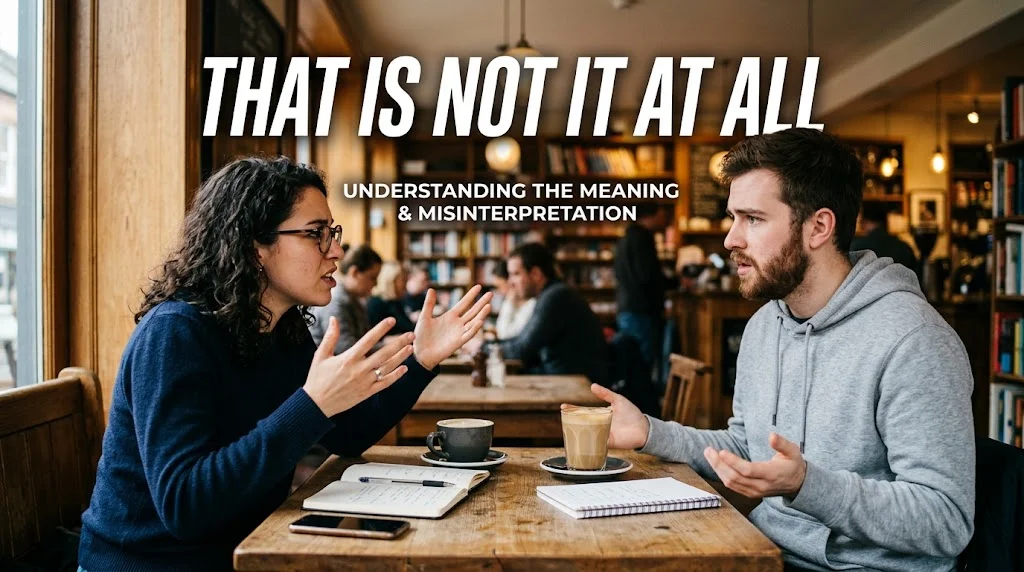
“That is not it at all” means that a person’s explanation, interpretation, assumption, or description is completely or substantially incorrect. It is commonly used when someone has misunderstood what another person means, what caused a situation, or what the central issue is. The phrase directly rejects the proposed interpretation and signals that a different explanation is needed.
Origin & History of “That Is Not It At All”
The expression “that is not it at all” does not have a single documented inventor or a famous historical origin. It is a natural English construction formed from ordinary elements: “that,” “is,” “not,” “it,” and “at all.”
The key intensifier is “at all.” In negative English constructions, “at all” has long been used to strengthen negation. For example, “I do not understand it at all” means the speaker has no understanding of the matter, while “That is not it at all” strongly rejects an interpretation.
The word “it” is particularly flexible in English. It can refer to an idea, explanation, answer, reason, intention, solution, or situation rather than a physical object. In this expression, “it” commonly refers to the correct interpretation of something under discussion.
Over time, the phrase became useful in ordinary spoken English because it allows speakers to correct an assumption quickly. Its modern use remains essentially the same: the speaker believes that the interpretation just offered is not the correct one.
The expression is not especially tied to one historical event, profession, or region. Its continued use reflects a broader feature of English communication: speakers frequently use short negative constructions to correct misunderstandings efficiently.
Synonyms & Alternatives by Tone

Professional & Neutral Alternatives
- That’s not quite right.
- That’s not the main issue.
- That’s not what I meant.
- That’s not the point.
- That’s not accurate.
Polite & Supportive Alternatives
- I think there may be a misunderstanding.
- Let me clarify what I mean.
- That’s slightly different from what I intended.
- I’d put it a little differently.
Encouraging & Reassuring Alternatives
- We’re close, but that’s not quite it.
- You’re on the right track, but there’s another point.
- That’s part of it, but not the whole picture.
- I see where you’re coming from, but that’s not exactly it.
Casual, Playful & Idiomatic Alternatives
- That’s not it.
- No, that’s not what I mean.
- That’s not the whole story.
- You’ve got the wrong idea.
- That’s way off.
- Not quite.
When Should You Use “That Is Not It At All”?
The phrase works best when you need to clearly correct an interpretation and the distinction matters.
Professional settings
In a workplace, it can be useful when a misunderstanding needs immediate correction. For example:
“Is the delay because the client rejected the proposal?”
“That is not it at all. The client approved it; the delay is on our side.”
The phrase is effective because it makes the correction unmistakable. However, in sensitive workplace situations, a softer alternative may protect the relationship better.
Casual conversations
The expression is natural among friends, family members, and people who already have a comfortable relationship.
“You’re upset because you lost the game?”
“That is not it at all. I’m frustrated because nobody listened.”
Here, the phrase helps distinguish the actual emotion or reason from an incorrect assumption.
Writing, presentations, and digital communication
In writing, the phrase can provide a strong transition when correcting a misconception:
“Some readers assume the problem is a lack of funding. That is not it at all. The larger issue is how resources are allocated.”
It is particularly useful when the writer wants to emphasize that a common interpretation is fundamentally mistaken.
When it is especially effective
Use it when:
- A misunderstanding is significant rather than minor.
- You need to make a clear distinction.
- The listener has confidently reached the wrong conclusion.
- The relationship allows relatively direct language.
- You intend to redirect the conversation toward the actual issue.
When Should You Avoid “That Is Not It At All”?
There are situations where the phrase may be unnecessarily blunt.
Overly formal situations
In formal correspondence, phrases such as “That interpretation is not accurate” or “I would like to clarify this point” may sound more controlled.
Legal, academic, or sensitive contexts
When precision matters, a categorical statement can create problems if the situation contains nuance. Instead of saying:
“That is not it at all.”
you might write:
“That interpretation does not fully reflect the evidence.”
This leaves room for distinctions and reduces the possibility of sounding dismissive.
Situations where nuance may be lost
Someone’s interpretation may be partly correct even if it does not explain the entire situation. In that case, “That is not it at all” can be too absolute.
For example, if workload really is one factor but not the primary factor, saying “That is not it at all” may inaccurately eliminate a relevant part of the explanation.
Is “That Is Not It At All” Professional, Polite, or Casual?
“That is not it at all” is grammatically correct and can be professional, but its tone is usually direct rather than especially soft or diplomatic.
Its formality is moderate. The phrase is not slang, but it is more conversational than highly formal alternatives such as “That interpretation is incorrect.”
Its emotional subtext depends heavily on delivery. A calm speaker can use it as a straightforward correction. A sharp voice can make it sound like “You completely misunderstood me.”
In professional communication, the phrase is safest when the correction needs to be clear, and the relationship can tolerate directness. When preserving rapport is more important, alternatives such as “That’s not quite what I meant” or “Let me clarify” are usually better.
Pros and Cons of Using “That Is Not It At All”
Advantages
- Clarity: It immediately signals that the proposed interpretation is wrong.
- Efficiency: It corrects a misunderstanding without requiring a long explanation before the correction.
- Accessibility: The vocabulary is simple and easy for most English speakers to understand.
Potential Drawbacks
- Oversimplification: The phrase can reject a partly correct interpretation.
- Tone mismatch: In a sensitive setting, it may sound dismissive or confrontational.
- Repetition: Frequent use can make a speaker sound overly corrective or negative.
Real-Life Examples of “That Is Not It At All” by Context
Emails
“I understand that you believe the report was delayed because we needed additional data. That is not it at all. The data was available last week; the delay resulted from the final review.”
This is clear but fairly direct. For a sensitive recipient, “That’s not quite what happened” may be more diplomatic.
Meetings
“So, are we saying the campaign failed because the budget was too small?”
“That is not it at all. The bigger problem was that we were targeting the wrong audience.”
The phrase works particularly well when a team needs to correct a mistaken assumption quickly.
Presentations
“You might think this chart shows declining customer interest. That is not it at all. It actually shows a shift from one product category to another.”
Here, the phrase creates a strong contrast between an initial interpretation and the evidence.
Conversations
“You think I’m angry because you canceled?”
“That is not it at all. I was worried because I hadn’t heard from you.”
The phrase helps distinguish an assumption about someone’s feelings from the speaker’s actual intention.
Social media
“People are assuming this update is about reducing features. That is not it at all. The goal is to make the existing features easier to use.”
On social media, however, the phrase can sound combative if the surrounding language does not establish a respectful tone.
“That Is Not It At All” vs Similar Expressions (Key Differences)
These expressions overlap, but they are not interchangeable in every situation. The main differences involve how strongly they reject an interpretation, how polite they sound, and whether they focus on the interpretation, the speaker’s intention, or the larger issue.
| Phrase | Meaning Difference | Tone Difference | Best Use Scenario |
| That’s not quite right. | Says something is incorrect without necessarily rejecting everything. | Polite, neutral, professional. | Correcting a minor or moderate misunderstanding. |
| That’s not what I meant. | Focuses specifically on the speaker’s intended meaning. | Personal, clear, relatively gentle. | Clarifying your own words or intentions. |
| That’s not the point. | Says the listener is focusing on the wrong issue. | Direct and sometimes firm. | Redirecting a discussion. |
| That’s not accurate. | Challenges factual correctness. | Professional and controlled. | Reports, analysis, workplace communication. |
| I think there may be a misunderstanding. | Indicates that communication has gone wrong without directly blaming someone. | Diplomatic and supportive. | Sensitive professional or interpersonal situations. |
| That’s way off. | Says the interpretation is significantly wrong. | Casual, blunt, sometimes playful. | Informal conversations where directness is acceptable. |
Common Mistakes & Misuse of “That Is Not It At All”
Overuse
Using the phrase every time someone offers an imperfect interpretation can make conversations feel adversarial. Not every difference requires a complete rejection.
Instead of repeatedly saying:
“That is not it at all.”
try varying your response:
“That’s partly right.”
“That’s one factor, but there’s more to it.”
“Let me explain the distinction.”
Incorrect context
The phrase may sound too casual for extremely formal documents. A legal or academic document often benefits from specific language that identifies exactly what is inaccurate.
Contradictory usage
Avoid saying “That is not it at all” when the previous statement is actually partly or mostly correct. If you agree with part of an interpretation, acknowledge that first.
Cultural misunderstandings
English learners may interpret the phrase as automatically rude. It is not inherently rude, but its directness can be stronger than expected in cultures where disagreement is normally expressed indirectly.
Conversely, native English speakers may interpret an abrupt “That is not it at all” as stronger criticism than the speaker intended.
Psychological Reason People Prefer “That Is Not It At All”
People often prefer concise corrective expressions because they reduce the amount of language needed to repair a misunderstanding.
Cognitive load reduction
A short statement immediately identifies the problem: the current interpretation is wrong. The speaker can then explain the correct interpretation.
Trust and authority signals
Confident language can sometimes signal that the speaker understands the subject. In professional settings, however, confidence works best when followed by evidence or clarification.
“That is not it at all. The figures show that customer retention actually increased.”
The second sentence supports the correction.
Attention economy
Modern communication often happens in environments where attention is limited. Short phrases can quickly signal that an important distinction is coming.
Modern communication habits
Emails, workplace chats, social media, and messaging platforms encourage concise responses. Expressions such as “Not quite,” “That’s not it,” and “That’s not what I meant” fit naturally into these fast exchanges.
US vs UK Usage of “That Is Not It At All”
The expression is understandable and grammatically natural in both American and British English. There is no major difference in its core meaning.
Popularity
Both US and UK speakers can use it in ordinary conversation and writing. Its meaning is generally transparent to speakers of both varieties.
Tone perception
American English may sometimes favor direct clarification in workplace and conversational settings, while British communication can, depending on context and speaker, favor more indirect formulations such as “I’m not sure that’s quite right.”
This is a tendency rather than a strict rule. Individual personality, workplace culture, age, and situation usually matter more than nationality.
Regional preferences
The main difference is often not vocabulary but degree of directness. A British speaker might choose a softer hedge in a formal conversation, while an American speaker may use the direct phrase without intending hostility. Both varieties contain speakers who use either style.
“That Is Not It At All” in Digital & Modern Communication
Emails
In email, the phrase is effective when a correction needs to be unmistakable. Because written communication lacks facial expression and vocal tone, however, adding an explanation can prevent the sentence from sounding unnecessarily harsh.
Slack / WhatsApp
Short messaging encourages expressions such as:
An emoji or additional context can soften the message in informal communication, although emojis are not appropriate for every professional relationship.
Social media
The phrase can be useful for correcting misconceptions, but public disagreement requires care. A direct correction may attract more attention while also increasing the risk of sounding argumentative.
AI-generated summaries
When an AI-generated summary misrepresents a user’s intended meaning, a human might respond:
“That is not it at all. The main point was the impact on customer retention.”
For AI-assisted writing, precise correction is particularly important because a summary can be technically coherent while still missing the intended emphasis.
Linguistic & Communication Insight
Emotional weight & subtext
Literally, “that is not it at all” rejects an interpretation. Pragmatically, it can communicate something stronger: “You have misunderstood the central point.”
That implied message is why context matters. The same words can sound helpful during a friendly clarification and dismissive during an argument.
Direct vs indirect phrasing
The expression is relatively direct because it begins with an explicit negative judgment. Compare:
“That is not it at all.”
with:
“I think there may be another way to look at it.”
The first prioritizes clarity and correction. The second prioritizes collaboration and reduced friction.
Neither approach is universally better. The appropriate choice depends on whether the immediate priority is accuracy, urgency, relationship management, or persuasion.
Professional communication perspective
At work, experienced communicators often separate the correction from the person. Instead of implying that someone is simply wrong, they explain what the actual issue is.
“That’s not quite the issue. The main concern is the timeline.”
This preserves authority while making the conversation easier to continue.
Pragmatic reasons for alternatives
Professionals may choose softer alternatives because they want to:
- reduce defensiveness;
- maintain collaboration;
- acknowledge another person’s perspective;
- preserve a productive working relationship;
- distinguish partial agreement from complete disagreement;
- encourage the other person to reconsider their interpretation.
Social signaling
Word choice signals how much respect, distance, urgency, and cooperation a speaker intends. “That’s way off” signals more informality and stronger disagreement than “I think there may be a misunderstanding.”
Tone & context guidance
Use “that is not it at all” when the distinction is important and direct correction is appropriate. Consider a softer alternative when speaking to a senior colleague, correcting someone publicly, discussing a sensitive issue, or communicating with someone who may interpret direct disagreement negatively.
Meaning, Usage & Examples for Each Alternative
That’s Not Quite Right
Meaning: This phrase means that something is incorrect or does not accurately reflect the situation, but it does not necessarily mean that everything is wrong. Why This Phrase Works: It corrects an error while leaving room for discussion and partial agreement. Real-World Usage Insight: It is one of the safest alternatives when you want to sound direct without sounding harsh. Best Use: Workplace discussions, classrooms, emails, and corrections. Avoid When: You need to emphasize that an interpretation is completely wrong. Tone: Polite, neutral, professional. US vs UK Usage: Natural in both; British speakers may use it especially comfortably as a softened correction. Example (Meeting): “That’s not quite right. The customer did approve the design; they asked us to change the delivery date.”
That’s Not What I Meant
Meaning: This phrase explains that another person has misunderstood the speaker’s intended message. Why This Phrase Works: It focuses on the speaker’s intention rather than directly judging the listener. Real-World Usage Insight: It is especially useful when your own wording is confusing. Best Use: Conversations, emails, interviews, and clarification. Avoid When: The problem concerns an objective fact rather than your intended meaning. Tone: Clear, personal, conversational. US vs UK Usage: Common and natural in both American and British English. Example (Email): “Thanks for checking. That’s not what I meant in the second paragraph—I was referring to the revised deadline, not the original one.”
Conclusion
“That is not it at all” is a clear, direct English expression used when someone wants to reject an incorrect interpretation, explanation, assumption, or conclusion. Although its meaning is straightforward, its tone can change significantly depending on the relationship between speakers, the communication setting, and the reason for correcting someone. In casual conversations, it can sound natural and emphatic. In professional or sensitive situations, softer alternatives such as “That’s not quite right,” “That’s not what I meant,” or “I think there may be a misunderstanding” can preserve clarity while reducing defensiveness.
Choosing the right alternative is especially important in emails, meetings, presentations, classrooms, and digital communication, where tone can easily be misunderstood. Ultimately, effective communication is not simply about saying that something is wrong; it is about explaining what is correct in a way that suits the audience and purpose. Understanding the phrase and its alternatives helps speakers and writers communicate disagreement with greater precision, confidence, and consideration.
FAQs
What does “that is not it at all” mean?
“That is not it at all” means that an interpretation, explanation, assumption, or conclusion is completely or substantially wrong. It is commonly used to correct a misunderstanding and emphasize that the actual meaning or reason is different. The expression is clear and natural but can sound firm depending on the speaker’s tone and context.
Is “that is not it at all” correct English?
Yes, “that is not it at all” is grammatically correct standard English. In everyday conversation, speakers often use the contracted form “that’s not it at all.” The phrase is understandable in both American and British English and is appropriate whenever someone needs to strongly reject an incorrect interpretation.
Is “that is not it at all” rude?
The phrase is not automatically rude, but it can sound blunt or dismissive when delivered sharply. With friends or familiar colleagues, it may be perfectly natural. In sensitive professional situations, alternatives such as “That’s not quite right” or “I think there may be a misunderstanding” usually sound more diplomatic.
What is a polite synonym for “that is not it at all”?
A polite alternative is “I think there may be a misunderstanding.” Other suitable options include “That’s not quite what I meant,” “Let me clarify,” and “That’s slightly different from what I intended.” These expressions correct the misunderstanding while showing respect and leaving room for further discussion.
What is the best professional alternative to “that is not it at all”?
“That’s not quite right” is one of the best general professional alternatives because it is clear without being overly confrontational. For factual errors, “That’s not accurate” works well. If the problem concerns the speaker’s intention, “That’s not what I meant” is more precise and natural.
Can I use “that is not it at all” in a professional email?
Yes, but use it carefully. It is suitable when a direct correction is necessary, especially with familiar colleagues. With clients, senior professionals, or sensitive topics, a softer phrase may be more effective. Adding a specific explanation after the correction can also make the email sound constructive rather than dismissive.
What is the difference between “that is not it at all” and “that’s not quite right”?
“That is not it at all” strongly rejects an interpretation and suggests that it misses the central point. “That’s not quite right” is softer and may imply that the person is partly correct. Therefore, “that’s not quite right” is generally better when you want to correct someone while maintaining a cooperative tone.
What is the difference between “that is not it at all” and “that’s not what I meant”?
“That is not it at all” can reject an explanation, assumption, or interpretation generally. “That’s not what I meant” specifically clarifies the speaker’s intended meaning. If another person has misunderstood your words or intentions, “That’s not what I meant” is usually the more accurate and natural choice.
Is “that is not it at all” formal or informal?
The phrase is neutral to conversational rather than highly formal. It is not slang, so it can appear in professional communication, but it may sound more direct than formal alternatives. In academic, legal, or highly sensitive writing, expressions such as “That interpretation is inaccurate” may provide greater precision.
Is “that is not it at all” used in American and British English?
Yes. “That is not it at all” and its contracted form “That’s not it at all” are understood in both American and British English. The core meaning is the same. Differences mainly involve communication style: some British speakers may prefer more indirect wording in formal situations, while American speakers may sometimes favor a more direct correction.

