
Imagine reading a workplace report that describes a colleague’s behavior as “odious.” The word is grammatically correct, but it immediately sounds strong, formal, and emotionally charged. In a casual conversation, you might say “awful,” “disgusting,” “unpleasant,” or “offensive” instead. Choosing the right alternative matters because synonyms are rarely identical in tone, intensity, or context.
Odious is a powerful English adjective used for something extremely unpleasant, offensive, hateful, or deserving strong dislike. It appears in literature, journalism, formal writing, criticism, and serious discussions, but it can sound unusually formal in everyday speech.
This guide explains what odious means, where the word came from, how native speakers perceive it, which alternatives work in professional and casual settings, and how to choose a more precise expression without sounding unnatural. Whether you are a student, professional, ESL learner, writer, or content creator, understanding these distinctions can help you communicate criticism with greater accuracy.
What Does “Odious” Mean?
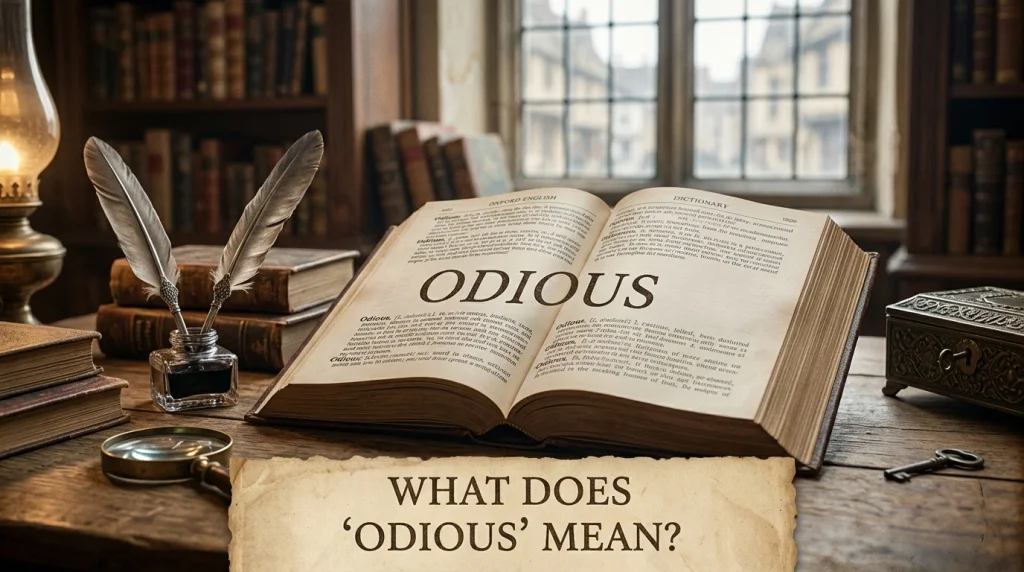
Odious means extremely unpleasant, offensive, hateful, or deserving strong dislike. The word is generally used to describe a person, behavior, action, idea, situation, or practice that causes intense disapproval or disgust. It is more formal and forceful than words such as “unpleasant” or “bad” and commonly appears in serious writing, criticism, and formal discussion.
Origin & History of “Odious”
The word odious comes from the Latin odiosus, meaning “hateful” or “full of hatred,” which is related to odium, meaning “hatred” or “hostility.” It entered English through Old French and developed into the modern adjective used to describe something intensely disliked or offensive.
Historically, the word was closely connected with hatred and strong moral disapproval. Over time, its use expanded beyond describing something literally hated to include actions, behavior, policies, conditions, or ideas considered deeply objectionable.
Today, odious remains relatively formal. A newspaper might describe an abusive practice as “odious,” while an everyday speaker is more likely to say “disgusting,” “awful,” or “horrible.”
The word is particularly useful when the writer wants to communicate strong disapproval without relying on profanity or highly emotional slang.
Synonyms & Alternatives by Tone
Professional & Neutral Alternatives
- Unpleasant
- Offensive
- Objectionable
- Reprehensible
- Distasteful
- Disagreeable
- Unacceptable
- Repugnant
Polite & Supportive Alternatives
- Concerning
- Difficult
- Problematic
- Uncomfortable
- Inappropriate
Encouraging & Reassuring
- Challenging
- Unfortunate
- Less than ideal
- Concerning
- Difficult to accept
Casual, Playful & Idiomatic Alternatives
- Awful
- Horrible
- Gross
- Disgusting
- Terrible
- Nasty
- Hard to stomach
- Really unpleasant
Not every alternative is a direct synonym. Odious carries a particularly strong sense of dislike or moral objection, so the best replacement depends on whether you want to emphasize unpleasantness, offensiveness, disgust, wrongdoing, or personal dislike.
When Should You Use “Odious”?

Odious works best when you need to express strong, serious disapproval and the context supports formal vocabulary.
Professional settings
The word can be appropriate in formal reports, opinion pieces, policy discussions, literary criticism, or carefully written commentary. For example:
“The report documented several odious practices that violated the organization’s ethical standards.”
However, it may sound unnecessarily dramatic in an ordinary workplace conversation.
Casual conversations
Native speakers understand odious, but it is not among the most common everyday choices. Saying “That was odious” can sound deliberately formal, literary, or emphatic.
In casual speech, awful, horrible, disgusting, nasty, or unpleasant may sound more natural.
Writing and presentations
The word can be effective in essays, editorials, historical writing, book reviews, and presentations when the subject genuinely warrants strong criticism.
For example:
“The author presents the character as an odious figure whose actions gradually isolate him from everyone around him.”
When it is especially effective
Use odious when:
- The subject deserves strong criticism.
- The writing is relatively formal.
- You want to emphasize intense dislike or moral objection.
- A stronger word than “unpleasant” is necessary.
- You want precise, elevated vocabulary without using slang.
When Should You Avoid “Odious”?
There are situations where odious can create the wrong impression.
Overly formal situations
Ironically, even though the word is formal, it can sound too literary for routine professional communication.
Instead of:
“Your proposal contains an odious error.”
A more constructive workplace alternative would be:
“There is a significant issue with this part of the proposal.”
Legal, academic, or sensitive contexts
In legal or academic writing, precision is usually more valuable than emotional intensity. Calling conduct odious may communicate a judgment rather than a neutral description.
When evidence and objectivity matter, terms such as unlawful, inappropriate, discriminatory, unethical, unsupported, or problematic may be more precise when factually justified.
Situations where nuance may be lost
“Odious” is broad. It tells readers that something is strongly disliked or objectionable, but it does not always explain why.
Is “Odious” Professional, Polite, or Casual?
Odious is formal and strongly negative. It is generally more professional in written criticism than in casual conversation, but it is not necessarily polite because it expresses intense disapproval.
Its emotional subtext can include:
- Strong dislike
- Moral disapproval
- Disgust
- Rejection
- Condemnation
- Serious criticism
The audience may perceive odious as educated, formal, literary, or forceful. In some settings, that makes it useful. In others, it can sound theatrical or overly severe.
A professional communicator should therefore consider not only whether the word is technically correct but also how the listener is likely to interpret the emotional force behind it.
Pros and Cons of Using “Odious”
Advantages
- Clarity: It clearly communicates strong dislike or objection.
- Efficiency: One word can express a substantial amount of negative evaluation.
- Accessibility: Most educated English speakers recognize its meaning, particularly in formal writing.
- Precision of intensity: It is stronger than simply saying something is “unpleasant.”
- Formal credibility: It can fit naturally into serious written analysis.
Potential Drawbacks
- Oversimplification: It may label something negatively without explaining the specific problem.
- Tone mismatch: It can sound too formal or dramatic in casual settings.
- Repetition: Repeated use can make writing feel exaggerated.
- Emotional judgment: It may be unsuitable when neutral language is required.
- Ambiguity of cause: It indicates strong dislike but does not always identify the reason.
Real-Life Examples of “Odious” by Context
Emails
“The audit identified several odious practices that require immediate review.”
This works in a formal internal report but would probably be too strong for a routine customer-service email.
Meetings
“I think we should avoid describing the entire process as odious. Two specific parts are creating serious problems.”
This shows how a speaker might recognize the word’s intensity while moving toward more precise language.
Presentations
“The documentary examines the odious conditions faced by workers during that period.”
Here, the formal tone fits the serious subject.
Conversations
“He has an odious personality.”
This is grammatically natural, but it sounds noticeably formal. In everyday conversation, “He’s really unpleasant” would usually sound more natural.
Social media
“Calling the practice odious may be justified, but explaining exactly what makes it harmful would make the argument stronger.”
On social media, the word can add emphasis but may also make a post sound more formal than necessary.
“Odious” vs Similar Expressions: Key Differences
| Phrase | Meaning Difference | Tone Difference | Best Use Scenario |
| Odious | Extremely unpleasant, hateful, or objectionable | Formal, forceful | Serious criticism and formal writing |
| Unpleasant | Simply causing discomfort or dislike | Neutral, mild | Everyday and professional communication |
| Offensive | Causes insult, outrage, or emotional offense | Neutral to strong | Comments, behavior, content, language |
| Disgusting | Produces strong disgust or revulsion | Strong, emotional, common | Casual speech and physical or moral disgust |
| Objectionable | Something considered unacceptable or open to criticism | Formal, restrained | Professional, academic, or policy writing |
| Reprehensible | Deserving serious moral condemnation | Very formal, serious | Ethics, misconduct, formal criticism |
Meaning differences
Odious focuses on intense dislike or objection. Unpleasant is considerably milder. Offensive specifically emphasizes offending. Disgusting highlights disgust, while objectionable emphasizes that something is unacceptable or open to criticism. Reprehensible carries a particularly strong moral judgment.
Tone differences
The biggest distinction is emotional intensity. “Unpleasant” is relatively gentle, while “disgusting” is emotionally direct. “Objectionable” is more restrained and professional. “Reprehensible” is highly formal and morally serious. Odious sits toward the stronger end while retaining an educated, formal character.
Best-use scenarios
Choose the word according to your purpose. Use unpleasant for mild problems, offensive for conduct that offends, disgusting for strong disgust, objectionable for formal criticism, and reprehensible for conduct that deserves serious moral condemnation.
Common Mistakes & Misuse of “Odious”
Overuse
Using odious for every negative situation weakens its impact. A late delivery may be inconvenient or disappointing; it is not automatically odious.
Incorrect context
The word usually describes something strongly objectionable or hateful. Using it merely as a sophisticated substitute for “bad” can make writing sound unnatural.
Contradictory usage
Avoid pairing odious with language that suggests approval unless the contradiction is deliberate.
For example:
“The odious but enjoyable restaurant…”
This creates confusion unless the writer clearly explains why the restaurant is being described in opposing ways.
Cultural misunderstandings
A word that sounds appropriately strong in formal writing may seem exaggerated in conversation. ESL learners should pay particular attention to register, or the level of formality expected in a situation.
Psychological Reasons People Prefer “Odious”
Language choices are influenced by how efficiently people communicate emotion, judgment, and social position.
Cognitive load reduction
A single adjective such as odious can summarize a strong negative evaluation without requiring a long explanation. However, efficient communication is not always precise communication. If the reason for the judgment matters, additional detail is useful.
Trust and authority signals
Formal vocabulary can sometimes make writing appear more authoritative. Words such as odious, reprehensible, objectionable, and unacceptable can signal that the writer is making a serious evaluation.
However, authority comes more reliably from specific evidence and clear reasoning than from sophisticated vocabulary alone.
Attention economy
Modern readers often scan content. A strong word can communicate the writer’s position immediately. This can be useful in headlines, commentary, reviews, or persuasive writing, provided the intensity is justified.
Modern communication habits
Digital communication favors short, familiar words. Consequently, awful, terrible, offensive, and disgusting are generally more conversational than odious.
US vs UK Usage of “Odious”
Odious is understood in both American and British English, and its core meaning remains essentially the same.
In both varieties, it is relatively formal and more common in writing than everyday conversation. British English may sometimes tolerate literary or formal vocabulary more comfortably in general prose, while American speakers may be more likely to choose direct alternatives such as awful, offensive, disgusting, or unpleasant in ordinary conversation.
There is no major difference in the fundamental definition. The main distinction is register and frequency, not meaning.
“Odious” in Digital & Modern Communication
Emails
In formal emails, odious can be effective when discussing serious misconduct or unacceptable practices, but it may sound accusatory when addressing an individual directly.
Slack / WhatsApp
In fast workplace chats or personal messaging, the word may feel unusually formal:
“That delay was odious.”
A more natural choice might be:
“That delay was really frustrating.”
Social media
On social platforms, odious can add a deliberately formal or rhetorical quality. Writers sometimes use such vocabulary to make criticism sound more polished.
AI-generated summaries
AI-generated writing can overuse words such as odious when summarizing strongly negative material. Human editors should check whether the word accurately reflects the source rather than simply choosing the strongest available synonym.
A useful rule is: describe the specific problem whenever possible instead of relying on an emotionally loaded adjective.
Hard to Stomach
Meaning: “Hard to stomach” is an idiomatic expression meaning difficult to accept, tolerate, or emotionally process. It often describes information, behavior, or situations rather than literal physical discomfort.
Why This Phrase Works: It communicates a strong personal reaction in a vivid but natural conversational way.
Real-World Usage Insight: The expression is useful when the speaker wants to emphasize emotional difficulty rather than simply label something as bad.
Best Use: Conversations, opinion writing, social commentary, and personal reflections.
Avoid When: Writing highly formal reports or technical documents.
Tone: Idiomatic, conversational, expressive.
US vs UK Usage: Well understood in both American and British English.
Example (Email / Message / Meeting): “The decision was hard to stomach for the staff who had spent months preparing for the project, especially after the reasons for the cancellation changed twice.”
Comparison Table of 10 Best Alternatives
The best alternative depends on what kind of negativity you want to communicate. The table below focuses on ten especially useful choices, ranging from mild professional language to stronger formal criticism.
| Phrase | Meaning | Best Use | Worst Use | Tone | US vs UK Usage |
| Unpleasant | Causes discomfort or dislike | Everyday and professional situations | Serious moral condemnation | Neutral, mild | Common in both |
| Offensive | Causes insult or emotional offense | Comments, conduct, content | Minor inconvenience | Direct, serious | Common in both |
| Objectionable | Open to criticism or unacceptable | Policies and formal writing | Casual conversation | Formal, restrained | Common in both |
| Reprehensible | Deserving moral condemnation | Serious misconduct | Small mistakes | Very formal, severe | Common in both |
| Distasteful | Unpleasant or socially inappropriate | Humor, advertising, behavior | Major wrongdoing | Polite, restrained | Common in both |
| Unacceptable | Fails to meet a standard | Workplace and policy communication | Personal preferences | Firm, professional | Very common in both |
| Repugnant | Extremely offensive or disgusting | Serious formal criticism | Minor complaints | Strong, formal | Used in both |
| Problematic | Creates difficulties or concerns | Workplace and academic discussion | Clear-cut serious misconduct | Measured, analytical | Very common in both |
| Inappropriate | Unsuitable for the situation | Workplace and social conduct | Physical disgust | Controlled, corrective | Common in both |
| Disgusting | Causes strong disgust | Casual speech and strong reactions | Diplomatic workplace feedback | Emotional, direct | Common in both |
The central lesson is that “odious” is not interchangeable with every negative synonym. . For serious moral condemnation, “reprehensible” or “repugnant” may be more precise.
For writers and ESL learners, the safest strategy is to choose the alternative based on meaning first and tone second. A sophisticated word is useful only when it accurately communicates the intended idea.
Conclusion
Understanding “odious” is about more than knowing that it means extremely unpleasant, offensive, or hateful. The word carries a strong emotional and formal tone, so choosing it correctly depends on context, audience, and intention. In professional or academic writing, alternatives such as objectionable, unacceptable, reprehensible, problematic, or inappropriate may provide greater precision. In everyday conversation, simpler choices such as awful, horrible, unpleasant, or disgusting often sound more natural. The best synonym is therefore not always the strongest one; it is the word that communicates the intended meaning without creating an unintended tone.
For students, ESL learners, professionals, and content writers, understanding these differences can improve clarity and make communication sound more natural. Whether you are describing behavior, policies, experiences, or ideas, consider both the literal meaning and emotional weight of the word. Used thoughtfully, odious remains a precise and powerful adjective for expressing strong disapproval.
FAQs
What does “odious” mean in simple English?
Odious means extremely unpleasant, offensive, hateful, or deserving strong dislike. It is stronger than words such as “unpleasant” or “disagreeable” and is usually associated with serious criticism. The word can describe people, behavior, actions, ideas, policies, or situations that cause intense disapproval or disgust.
Is “odious” a negative word?
Yes, odious is strongly negative. It communicates intense dislike, disapproval, or rejection rather than mild dissatisfaction. Depending on context, it can suggest that something is deeply offensive, morally objectionable, or extremely unpleasant. Because of its strong emotional weight, it should be used when the seriousness of the criticism is genuinely intended.
Is “odious” a formal word?
Yes. Odious is generally considered a formal or literary word, particularly compared with everyday alternatives such as “awful,” “horrible,” or “nasty.” It appears more often in essays, journalism, literature, formal criticism, and serious discussions than in casual conversation. Using it in a workplace chat may sound unusually formal or dramatic.
What are the best synonyms for “odious”?
Useful synonyms include unpleasant, offensive, objectionable, reprehensible, distasteful, unacceptable, repugnant, and disgusting. The best choice depends on the intended meaning. “Offensive” emphasizes insult, “disgusting” emphasizes revulsion, “unacceptable” focuses on standards, and “reprehensible” emphasizes serious moral wrongdoing.
What is a polite alternative to “odious”?
Unpleasant, concerning, problematic, inappropriate, and distasteful can be more diplomatic alternatives. The right choice depends on the situation. For example, “problematic” works well for professional feedback because it identifies a concern without making an extremely harsh judgment. “Distasteful” is useful when something is socially inappropriate or offensive without necessarily being seriously harmful.
Can “odious” describe a person?
Yes. Odious can describe a person whose behavior, character, or presence causes intense dislike. For example, “The novel portrays him as an odious character.” However, directly calling a real person “odious” can sound harsh and personally insulting, particularly in professional settings. Describing the specific behavior is often clearer and more constructive.
What is the difference between “odious” and “disgusting”?
Both words communicate strong negativity, but their emphasis differs. Odious often suggests intense dislike, hatred, or moral objection and has a formal tone. Disgusting more directly describes something that causes disgust or revulsion and is much more common in everyday speech. “Odious” suits formal criticism, while “disgusting” is more conversational.
What is the difference between “odious” and “unpleasant”?
Unpleasant is much milder than odious. Something unpleasant may simply be uncomfortable, annoying, or undesirable, while something odious is extremely objectionable or hateful. For example, an uncomfortable meeting can be unpleasant, whereas deliberately cruel behavior might reasonably be described as odious. The choice depends mainly on the severity of the situation.
Is “odious” commonly used in American and British English?
Yes, odious is understood in both American and British English and has essentially the same meaning in each variety. It is relatively formal in both. Everyday speakers in either region are generally more likely to use words such as “awful,” “horrible,” “offensive,” or “unpleasant,” while “odious” appears more frequently in formal or written contexts.
What is a good professional alternative to “odious”?
The best professional alternative depends on what you are criticizing. Unacceptable works when something violates a standard, problematic suits collaborative feedback, inappropriate describes unsuitable behavior, and objectionable works for formal criticism. These alternatives can communicate disagreement clearly while reducing the emotional force that “odious” may carry in workplace communication.

