
Imagine a manager explaining why a company’s rapid growth has created both new opportunities and new operational problems. She might say, “Growth and growing pains are two sides of the same coin.” The expression quickly communicates that two apparently different ideas are closely connected.
“Two sides of the same coin” is a widely used English idiom for describing two aspects of the same situation, issue, or underlying reality. It is especially useful when two things seem different—or even opposite—but are connected importantly. Cambridge defines the expression as referring to things that are different but closely related, while Merriam-Webster describes them as two parts of the same thing. (Cambridge Dictionary)
For professionals, students, ESL learners, and writers, understanding this phrase is about more than memorizing a definition. The alternative you choose can change the level of formality, emotional weight, precision, and implied relationship between two ideas. In a workplace email, “closely related issues” may sound more neutral than “two sides of the same coin.” In a presentation, however, the idiom can make a complex relationship easier to understand.
What Does “Two Sides of the Same Coin” Mean?
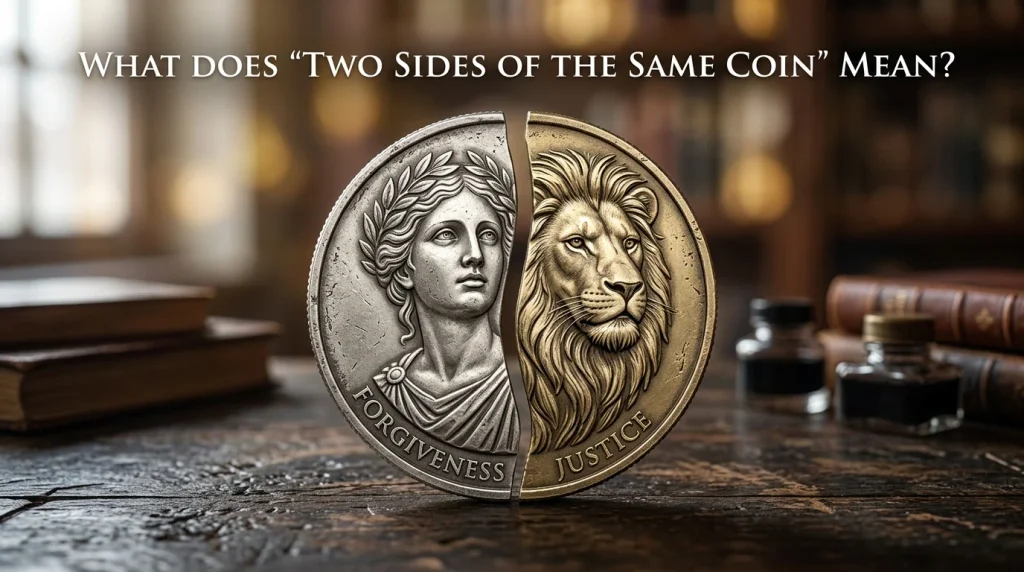
“Two sides of the same coin” means that two things are different aspects, forms, or perspectives of the same underlying situation. The expression is commonly used when ideas appear separate or contrasting but share an important connection. It can describe related problems, benefits and drawbacks, opposing perspectives, behaviors, policies, or outcomes.
In simple English, if two things are “two sides of the same coin,” they are different but connected parts of one situation.
For example:
- Success and pressure can be two sides of the same coin.
- Freedom and responsibility are sometimes two sides of the same coin.
- Convenience and privacy concerns can be two sides of the same coin.
- Competition and collaboration can become two sides of the same coin in modern workplaces.
The expression does not necessarily mean that the two things are identical. Instead, it highlights an underlying relationship between them. Cambridge similarly notes that the things may seem different while being very closely related. (Cambridge Dictionary)
Origin & History of “Two Sides of the Same Coin”
The expression comes from the literal physical structure of a coin: a single coin has two surfaces, but both belong to the same object. The metaphor therefore provides a straightforward way to describe two distinct aspects of one larger thing.
The idiom is generally traced to the 19th century, although determining one precise person or publication that first coined the modern expression is difficult. Sources discussing idiom history commonly place its emergence in the mid-19th century. (Idiom Origins)
The related expression “the other side of the coin” developed as a way of referring to the contrasting or opposite aspect of an issue. Oxford’s dictionary records “the other side of the coin” as the aspect of a situation that contrasts with the one already being discussed, while it describes “two sides of the same coin” as two ways of looking at the same situation. (Oxford Learner’s Dictionaries)
Over time, the phrase expanded beyond literal discussions of money. It became a flexible tool for discussing:
- opposing opinions
- benefits and disadvantages
- social problems
- personality traits
- business decisions
- political or economic issues
- emotional experiences
- technological developments
- competing priorities
Its continued popularity comes partly from its efficiency. Rather than explaining a complex relationship in several sentences, a speaker can say that two ideas are two sides of the same coin and invite the audience to look for the connection.
Synonyms & Alternatives by Tone
There is no perfect one-word synonym for “two sides of the same coin.” The best alternative depends on whether you want to emphasize similarity, contrast, connection, perspective, or two parts of one larger situation.
Professional & Neutral Alternatives
- Two aspects of the same issue
- Two facets of the same issue
- Different sides of the same issue
- Closely related aspects
- Interconnected aspects
- Two parts of the same whole
- Related perspectives
- Different perspectives on the same issue
Polite & Supportive Alternatives
- Different perspectives on the same situation
- Related points of view
- Two connected aspects
- Complementary perspectives
- Different ways of looking at the issue
- Related considerations
Encouraging & Reassuring Alternatives
- Two parts of the same process
- Different aspects of the same experience
- Connected challenges and opportunities
- Related parts of the bigger picture
- Two elements that work together
- Different paths toward the same goal
Casual, Playful & Idiomatic Alternatives
- Two sides of the issue
- The flip side
- The other side of the coin
- Two sides of the same story
- Different sides of the same situation
- Both sides of the picture
- Two parts of the same puzzle
When Should You Use “Two Sides of the Same Coin”?
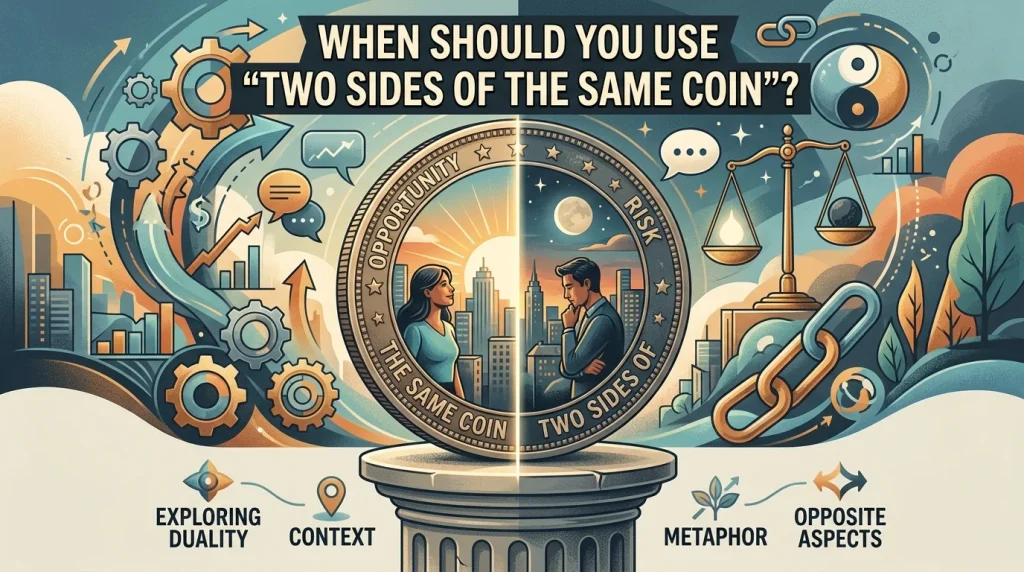
The phrase works best when you want to emphasize connection despite difference.
Professional settings
In professional communication, it can be useful when discussing:
- benefits and drawbacks
- business opportunities and risks
- employee autonomy and accountability
- innovation and disruption
- customer expectations and operational demands
- efficiency and quality
For example:
“Automation and workforce reskilling are two sides of the same coin.”
This sentence suggests that the two topics should be considered together rather than separately.
Casual conversations
The phrase is natural in everyday speech:
“Being independent and asking for help can be two sides of the same coin.”
It can make a complicated observation sound conversational without becoming overly informal.
Writing, presentations, and digital communication
The idiom is particularly effective in:
- opinion articles
- presentations
- essays
- business reports
- blog posts
- LinkedIn posts
- explanatory content
- interviews
It is useful when the writer wants to establish a relationship between two concepts without spending too much space explaining the connection.
When it is especially effective
Use the phrase when:
- Two ideas are genuinely connected.
- The contrast is meaningful.
- The audience understands the metaphor.
- You want concise, accessible language.
- You want to emphasize a shared underlying issue.
When Should You Avoid “Two Sides of the Same Coin”?
The expression is useful, but it is not appropriate everywhere.
Overly formal situations
In highly formal writing, a direct alternative may be clearer:
“These are two related aspects of the policy.”
This can be preferable to an idiom in formal reports or technical documentation.
Legal, academic, or sensitive contexts
In legal or highly technical writing, precision is often more important than stylistic familiarity. If two issues have a specific legal or technical relationship, state that relationship directly.
For example, instead of:
“The two provisions are two sides of the same coin.”
consider:
“The provisions address different aspects of the same regulatory requirement.”
Situations where nuance may be lost
The idiom can unintentionally imply that two issues are equally connected or equally important.
That can be misleading when:
- one factor is the main cause, and the other is an effect;
- two issues are related but not equally significant;
- one idea is the direct opposite of the other;
- the relationship is complicated or disputed.
Use a more precise expression when the exact relationship matters more than rhetorical simplicity.
Is “Two Sides of the Same Coin” Professional, Polite, or Casual?
“Two sides of the same coin” is generally neutral to moderately conversational. It is not slang, but it is still an idiomatic expression rather than highly formal language.
Tone analysis
The phrase can sound:
- Professional: in presentations, meetings, and business writing
- Neutral: in general explanatory writing
- Conversational: in everyday discussions
- Reflective: when discussing complex human or social issues
- Slightly rhetorical: when used to make a persuasive point
Formality level
It sits comfortably between formal and casual English. It is more polished than slang such as “two peas in a pod,” but less technical than “two interdependent variables.”
Emotional subtext
The phrase can subtly suggest that the speaker sees unity beneath apparent difference. That can make a statement sound balanced and thoughtful.
However, it may also sound dismissive if the speaker uses it to flatten a serious disagreement.
For example:
“The two political positions are just two sides of the same coin.”
Depending on context, this may suggest that both positions are fundamentally similar. Someone who strongly supports one position may interpret the statement as minimizing a genuine difference.
Pros and Cons of Using “Two Sides of the Same Coin”
Advantages
- Clarity: It quickly communicates a relationship between two ideas.
- Efficiency: It expresses a complex relationship in a short phrase.
- Accessibility: Most fluent English speakers understand it easily.
- Memorability: The coin image makes the idea easy to remember.
- Versatility: It works in speech, writing, presentations, and digital communication.
- Balanced framing: It can acknowledge differences without treating the ideas as completely separate.
Potential Drawbacks
- Oversimplification: Complex relationships may be reduced to a simple binary.
- Tone mismatch: An idiom may be too conversational for highly technical writing.
- Repetition: Frequent use can make writing feel formulaic.
- False equivalence: It may imply that two ideas are equally important.
- Ambiguity: Readers may not know exactly what relationship the writer intends.
Real-Life Examples of “Two Sides of the Same Coin” by Context
Emails
“Customer growth and support capacity are two sides of the same coin, so I think we should review both before setting next quarter’s targets.”
This sounds professional while still being natural.
Meetings
“We keep talking about speed and accuracy as separate goals, but they’re really two sides of the same coin.”
The phrase works well when someone wants to reframe a discussion.
Presentations
“Data accessibility and data security are often treated as competing priorities, but they can be two sides of the same coin.”
This creates a concise transition between related ideas.
Conversations
“Being confident and being willing to admit mistakes are two sides of the same coin.”
The phrase sounds natural in reflective conversation.
Social media
“Remote work gives people flexibility, but it can also blur work-life boundaries. Two sides of the same coin.”
The shortened structure works particularly well in social posts.
“Two Sides of the Same Coin” vs Similar Expressions (Key Differences)
These expressions overlap, but they do not communicate the same idea.
| Phrase | Meaning Difference | Tone Difference | Best Use Scenario |
| Two sides of the same coin | Two different aspects of one underlying situation | Neutral, idiomatic | Explaining connected contrasts |
| Two sides of the same issue | Two perspectives or positions concerning one issue | Neutral, direct | Discussions and analysis |
| The other side of the coin | The contrasting aspect of something already discussed | Conversational, idiomatic | Introducing a drawback or alternative |
| Different sides of the same story | Different interpretations or accounts of one event | Conversational | Conflicting viewpoints |
| Two parts of the same whole | Separate components that together form one larger thing | Formal, neutral | Academic or professional writing |
| Two facets of the same issue | Distinct features of one complex issue | Professional, analytical | Reports and essays |
| Two sides of the issue | Two positions or viewpoints, often in disagreement | Neutral | Debate and discussion |
Meaning differences
“Two sides of the same coin” emphasizes an underlying connection. “The other side of the coin” usually introduces a contrasting consideration. “Different sides of the same story” focuses more strongly on competing interpretations.
Tone differences
“Two parts of the same whole” is more literal and formal. “The other side of the coin” is more conversational. “Two facets of the same issue” sounds more analytical and is often preferable in professional writing.
Best-use scenarios
Choose the phrase based on the relationship you want to highlight.
Common Mistakes & Misuse of “Two Sides of the Same Coin”
Overuse
Using the idiom repeatedly can make an article, presentation, or speech sound predictable.
Instead of writing:
“Innovation and risk are two sides of the same coin.”
followed by another similar sentence, vary your language:
“Innovation and risk are closely connected.”
Incorrect context
Do not use the expression merely because two things appear together.
Two things need a meaningful underlying relationship.
Incorrect:
“The meeting room and the coffee machine are two sides of the same coin.”
There is no obvious conceptual relationship.
Contradictory usage
The phrase usually indicates that two things belong to the same underlying situation. Avoid using it when you actually mean that two ideas are unrelated opposites.
Cultural misunderstandings
Idioms can be challenging for ESL learners because their meaning cannot always be understood literally. A learner may interpret the phrase as referring to physical sides of a coin rather than related aspects of one issue.
For international audiences, a direct alternative such as “two related aspects of the same issue” may sometimes be clearer.
Psychological Reasons People Prefer “Two Sides of the Same Coin”
Cognitive load reduction
The phrase gives readers a familiar mental structure: one object, two sides. That makes an abstract relationship easier to process.
Instead of explaining:
“These two apparently different outcomes originate from the same underlying circumstances.”
a writer can say:
“They are two sides of the same coin.”
The reader can process the relationship quickly.
Trust and authority signals
Well-established idioms can make communication sound fluent and confident. In moderation, the phrase can help a speaker present an interpretation without using excessive explanation.
However, idiomatic language does not automatically make an argument correct. The underlying evidence still matters.
Attention economy
Modern readers often scan emails, articles, presentations, and social posts. Familiar expressions can communicate relationships efficiently.
Modern communication habits
Digital communication favors short, recognizable language. This helps explain why the phrase continues to appear in professional posts, commentary, interviews, articles, and online discussions. Current dictionary examples show the idiom being used across subjects including business, politics, culture, economics, and social issues. (Merriam-Webster)
US vs UK Usage of “Two Sides of the Same Coin”
The expression is understood in both American and British English and does not have a major difference in basic meaning.
Popularity
There is no important regional difference in definition. Dictionaries serving both American and British learners recognize the expression.
Tone perception
In both varieties, it is generally understood as an idiomatic but respectable expression. It can appear in journalism, business discussions, academic-adjacent writing, and everyday speech.
Regional preferences
British English also commonly uses related expressions such as “the other side of the coin.” American English uses both forms as well.
The main difference is therefore not meaning but individual style and context. A British or American professional may choose a more direct expression when writing highly formal or technical material.
Conclusion
The phrase “two sides of the same coin” is a useful English idiom for explaining two different but closely connected aspects of the same situation. Its familiar meaning makes it effective in conversations, professional communication, presentations, articles, and digital content. However, choosing the right alternative depends on your audience, purpose, and desired tone. Expressions such as “two aspects of the same issue,” “different perspectives,” “two connected aspects,” and “the other side of the coin” can provide greater precision or a different emotional effect.
For ESL learners and content writers, understanding these distinctions helps make communication more natural and contextually appropriate. The key is not simply knowing what the idiom means, but recognizing when it accurately describes the relationship between two ideas. When used thoughtfully, “two sides of the same coin” can make complex relationships easier to understand while keeping language concise, familiar, and engaging.
FAQs
What does “two sides of the same coin” mean?
“Two sides of the same coin” means two different aspects of the same situation, issue, or underlying reality. The ideas may appear different or contrasting, but they are closely connected. For example, freedom and responsibility can be described as two sides of the same coin because greater freedom often comes with greater responsibility.
Is “two sides of the same coin” an idiom?
Yes. “Two sides of the same coin” is an English idiom used to describe two closely related aspects of one situation. Its meaning comes from the literal idea that one coin has two sides. Today, it is commonly used in everyday conversations, professional discussions, essays, presentations, journalism, and online communication.
Is “two sides of the same coin” professional?
Yes, it can be professional, although it is somewhat idiomatic and conversational. It is appropriate for many meetings, presentations, emails, and business discussions. In highly formal, technical, legal, or academic writing, a clearer alternative such as “two aspects of the same issue” may be preferable when precision is important.
What are the best synonyms for “two sides of the same coin”?
Useful alternatives include “two aspects of the same issue,” “two facets of the same issue,” “different perspectives on the same issue,” “two connected aspects,” “two parts of the same whole,” and “the other side of the coin.” The best choice depends on whether you want to emphasize connection, contrast, perspective, or formality.
What is the difference between “two sides of the same coin” and “the other side of the coin”?
“Two sides of the same coin” emphasizes that two different aspects belong to the same underlying situation. “The other side of the coin” usually introduces a contrasting or less obvious aspect of something already mentioned. Both expressions are idiomatic, but the second is particularly useful when shifting attention to an alternative or drawback.
Can “two sides of the same coin” be used in an email?
Yes. The expression can work naturally in professional emails when two issues are closely connected. For example: “Customer growth and support capacity are two sides of the same coin, so we should consider both before setting our targets.” For highly formal correspondence, a direct phrase may provide
What is the difference between “two sides of the same coin” and “two sides of the same story”?
“Two sides of the same coin” describes different aspects of one underlying situation. “Two sides of the same story” usually describes different accounts, interpretations, or perspectives about an event. Therefore, the first focuses on connected aspects, while the second is more appropriate when people may describe or interpret the same event differently.
Can I use “two sides of the same coin” in academic writing?
Yes, but use it selectively. The idiom is understandable and can make an academic discussion more readable, particularly in essays or general-interest research writing. However, highly technical academic work often benefits from precise wording. Instead of the idiom, you might write “two related aspects of the issue” when the exact relationship needs to be clearly defined.
Why is “two sides of the same coin” so commonly used?
The expression is popular because it communicates a potentially complex relationship quickly and uses an easily understood mental image. It tells readers that two ideas are distinct but connected. This makes it useful in conversations, business communication, presentations, articles, social media, and explanatory writing where clarity and brevity are important.

